Bearing Precision Grades Explained: ISO, ABEC & How to Choose

HAICHUAN-deep groove ball bearing precision grades

Two bearings look identical on the outside. One runs smooth for 20,000 hours; the other vibrates itself apart in six months. The difference? Bearing precision grades — a specification that controls manufacturing tolerances and directly dictates vibration, noise, speed capability, and service life. Higher precision means tighter tolerances but also higher cost. The smart move isn’t picking the highest grade — it’s matching the grade to your application. A conveyor motor runs fine on P0; a CNC spindle demands P4. What follows is a field guide to each grade, how the major standards compare, and where the cost traps hide.

What Is Bearing Precision?

Bearing precision is the tightness of a bearing’s manufactured dimensions and running behavior against specified limits — in plain terms, how much error the production process leaves in.
Two categories define it:
Dimensional Accuracy:
Controls deviations in bore diameter tolerance, outer ring diameter, and width — the static, measurable dimensions.
Running Accuracy:
Controls radial runout, axial runout, and rotational deviation — the dynamic behavior when the bearing actually spins.
Here’s what many buyers overlook: running accuracy matters more than dimensional accuracy. A bearing can have perfect bore dimensions yet still vibrate under load if its running accuracy is poor. When evaluating bearing fit, always check runout values alongside nominal sizes — not just the latter.

Why Bearing Precision Matters

Precision grade touches nearly every performance metric you care about. Four areas bear the brunt:

Better Machine Accuracy

Tighter precision keeps rotating elements better balanced, reducing centrifugal forces and friction at elevated RPMs. P4 bearings in CNC spindles routinely handle speeds that would destroy a P0 bearing within hours.

Noise and Vibration Reduction

Reduced internal play translates to smoother rotation and quieter operation — critical for electric motors, household appliances, and automotive wheel hubs where NVH standards are strict.

Longer Service Life

Lower runout and better raceway surface finishes distribute loads more evenly across rolling elements, slowing fatigue and extending maintenance intervals.

Longer Service Life

Precision bearings transfer rotational accuracy directly to the workpiece. A machine tool’s positioning repeatability depends on spindle bearing precision as much as on its CNC controller.

Bearing Precision Standards

Four standards bodies define bearing precision grades. The labels differ, but the tolerance frameworks underneath are closely aligned:

ISO Standards

The baseline for global sourcing. ISO 492 defines classes P0 through P2, and most international spec sheets reference these labels directly.

DIN Standards

Germany’s DIN 620 mirrors ISO tolerances so closely that the two are often used interchangeably in European automotive and industrial specs.

JIS Standards

Japan’s JIS B 1514 uses the same P0–P2 labeling — which means Asian-manufactured bearings drop into ISO-based specs with minimal translation friction.

ANSI/ABEC Standards

The American system takes a different approach: ABEC rates ball bearings from 1 to 9, with higher numbers meaning tighter tolerances. The numbering doesn’t match ISO, but the tolerance bands align closely enough for practical cross-referencing.

In practice: These standards aren’t identical, but their tolerance ranges overlap substantially. A P5 bearing and an ABEC 5 bearing perform comparably in most real-world applications. Understanding these bearing precision grades helps you cross-reference specifications across regional standards.

ISO Bearing Precision Classes

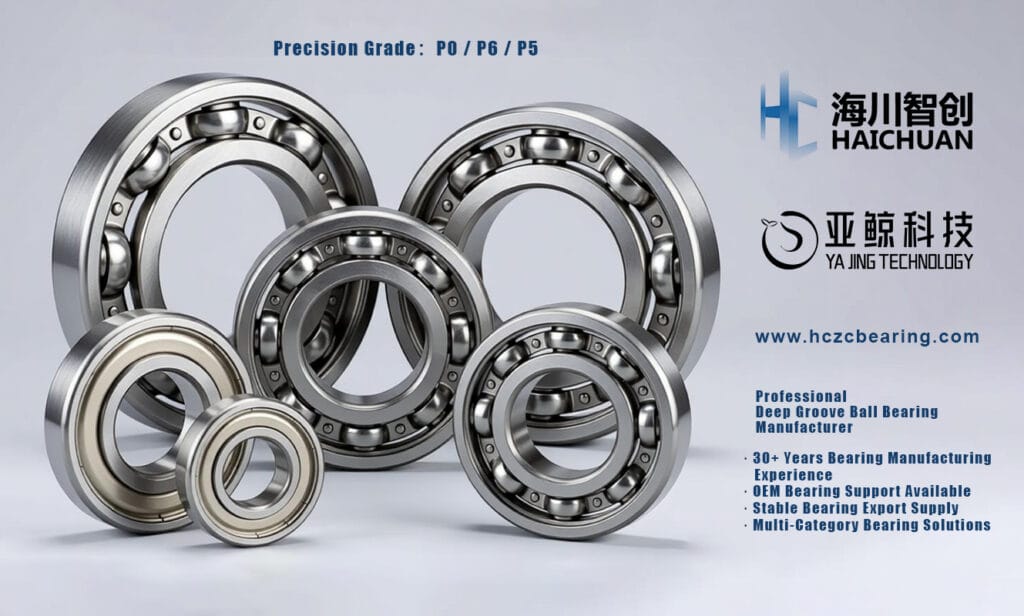
ISO defines five primary precision classes, each serving a distinct application tier:
P0 (Normal/PN): The baseline and most widely used grade worldwide. Adequate for general-purpose motors, agricultural machinery, conveyors, and pumps where moderate speed and standard accuracy suffice. Over 70% of bearings produced are P0.
P6: A step up in precision, reducing runout by roughly 30–50% versus P0. Common in industrial electric motors, gearboxes, and medium-to-high-speed equipment where lower vibration is expected.
P5: High-precision grade for applications demanding tight rotational accuracy. Used in machine tool spindles, precision instruments, and high-speed pumps where vibration control directly affects output quality.
P4: Ultra-precision territory. Found in CNC machining centers, precision grinders, and high-speed dental handpieces. Tolerances are measured in single-digit micrometers — for context, a human hair is about 70 μm thick.
P2: Among the highest precision grades commercially available. Reserved for aerospace gyroscopes, ultra-high-speed spindles, and specialized scientific instruments where no performance compromise is acceptable.

GradeAccuracySpeedCostTypical Applications
P0StandardMediumLowGeneral Machinery
P6HigherMedium-HighMediumMotors
P5HighHighHigherMachine Tools
P4Very HighVery HighExpensiveCNC Spindles
P2Ultra HighExtremeVery ExpensiveAerospace
Reference for matching precision grades to application requirements

ABEC vs ISO Precision Grades

One of the most searched questions in bearing sourcing: how do ABEC ratings map to ISO precision grades? Here’s the cross-reference:

ISOABEC
P0ABEC 1
P6ABEC 3
P5ABEC 5
P4ABEC 7
P2ABEC 9

This mapping is a useful guideline but not a strict equivalence. ABEC standards focus primarily on dimensional and running accuracy for ball bearings, while ISO classes apply more broadly across bearing types. For practical B2B sourcing, ABEC 5 and P5 are generally treated as interchangeable — but always confirm with your supplier for critical applications. One measurable difference: at a 20 mm bore, ABEC 7 tolerances are roughly four times tighter than ABEC 1. On the market side, ABEC 5-grade bearings make up about half of global precision bearing revenue — a reflection of how many applications land in that middle tier.

Precision Grade vs Bearing Clearance

These two specs are frequently confused, yet they govern entirely different properties:
Precision grade controls manufacturing accuracy — how closely the bearing matches its specified dimensions and running behavior.
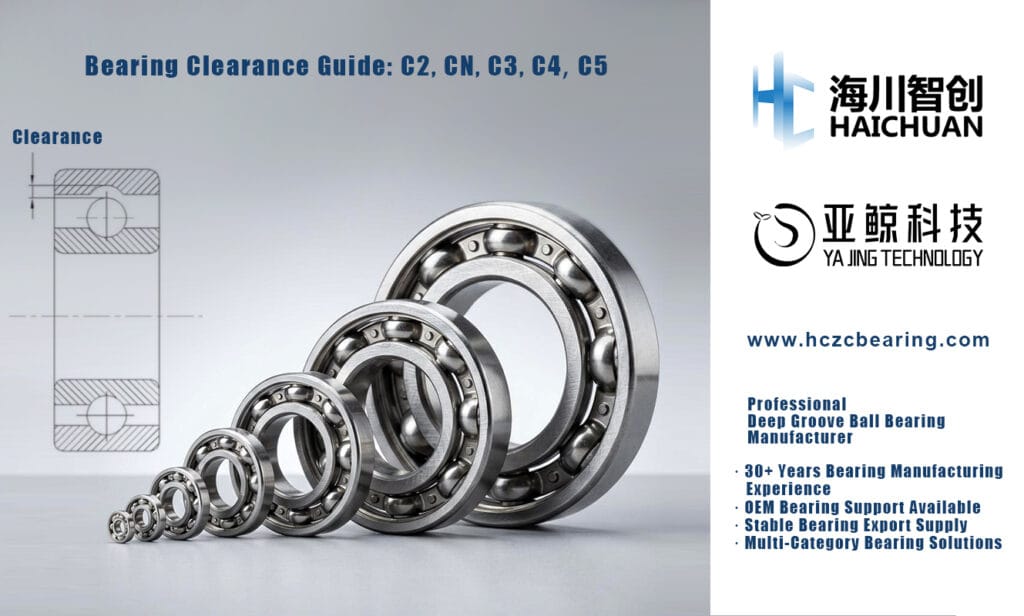
Bearing clearance controls the internal radial and axial free movement between rings before mounting.
A bearing marked 6205 P5 C3 tells you both: P5 is the precision grade, C3 is the internal clearance. You can pair a P0 bearing with C3 clearance, or a P5 bearing with C0 clearance. They’re independent selections. Clearance handles thermal expansion and interference fit during operation; precision handles running accuracy and vibration. Different engineering problems, different dials.

Precision Grade vs Bearing Material

Another mix-up we see often: material specification is not a precision grade.
GCr15 (Chinese standard) and 52100 (AISI/SAE) are through-hardened bearing steels — the most common material choices for standard and precision applications.
440C is a martensitic stainless steel for corrosive or food-grade environments.
A GCr15 bearing can be P0 or P4. A 52100 bearing can be P6 or P5. Material and precision are separate decisions in your spec sheet — pick material for environment and load, pick precision for running performance.

How to Choose the Right Bearing Precision Grades

Selecting the right grade is about matching application demands, not maximizing specs. Here’s a practical selection guide:

ApplicationRecommended GradeReason
General Machinery (conveyors, fans)P0Standard accuracy sufficient; cost-effective
Electric Motors (standard industrial)P6Lower vibration and noise expected
Pumps (centrifugal, submersible)P0 / P6Depends on speed and noise requirements
Machine Tools (lathes, mills)P5Positioning accuracy and surface finish critical
CNC Spindles (high-speed machining)P4Ultra-precision for tight tolerances at high RPM
Aerospace (gyros, actuators)P2Maximum reliability under extreme conditions
How to decide: Start with P0 and upgrade only when the application demands it. If noise or vibration complaints arise, move to P6. If positioning accuracy or surface finish quality is the issue, P5 or P4 is warranted. Cost matters. Dropping from P5 to P6 saves roughly 50% on the bearing — money better spent elsewhere if P6 does the job. Also consider bearing fit requirements — tighter precision grades may demand different shaft and housing tolerances.

Frequently Asked Questions (FAQ)

1.What is the difference between P0 and P6 bearings?

P6 has 30–50% tighter runout tolerances than P0, making it suitable for higher-speed, lower-vibration applications such as industrial electric motors.

2.Is ABEC 5 equal to P5?

They’re closely matched in tolerance bands but not strictly identical. For most applications, they’re treated as equivalent in B2B specifications.

3.Is Higher Precision Always Better?

No. Over-specifying precision wastes budget and can even reduce performance — tighter internal clearances may cause overheating in applications designed for looser running fits.

4.Can P4 Bearings Replace P0 Bearings?

Technically yes, but rarely justified. You’re paying 3–5× more for precision you don’t use, and the tighter tolerances may require different mounting practices and lubrication regimes.

5.How do I choose the right bearing precision?

Match the grade to your application’s speed, accuracy, and noise requirements. Start with P0 and upgrade only when performance demands it.

Conclusion

Bearing precision grades determine running quality — vibration, noise, speed capability, and positioning accuracy. P0 covers most general applications; P6 suits standard electric motors; P5 and P4 serve machine tools and CNC spindles; P2 is reserved for aerospace.
The right grade is the one that meets your application without paying for precision you’ll never use. Higher doesn’t mean better — it means more expensive, and sometimes shorter-lived.
Not sure which precision grade fits your application? Share your operating conditions with our engineering team — we’ll help you specify the right grade without overpaying. Contact our team HAICHUAN→

Scroll to Top