Bearing Clearance Guide: C2, CN, C3, C4 & C5 Explained
Selecting the wrong bearing clearance class is one of the most common causes of premature bearing failure. A motor designed for C3 clearance that gets fitted with CN bearings can overheat and seize within weeks, not years. The difference often comes down to clearance class. What follows is a practical reference for each class (C2, CN, C3, C4, C5), how clearance relates to precision and preload, and how to specify the right one when ordering.
Key Takeaways
Bearing clearance is a deliberate design parameter: the internal free space between rolling elements and raceways, not a manufacturing defect.
Interference fit consumes 60–80% of the interference amount as lost clearance (per NTN engineering data); a 50°C temperature differential removes another 5–10 µm.
C3 is the industry-standard clearance class for electric motors because it compensates for fit and thermal expansion that would push CN to zero or negative clearance.
What Is Bearing Clearance?
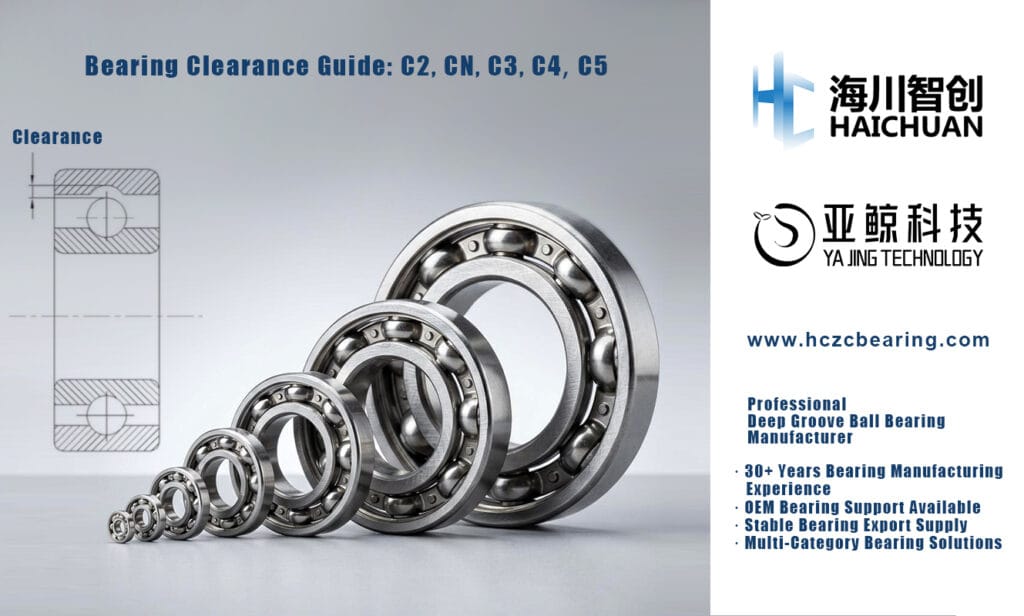
Bearing clearance is the distance one bearing ring can move relative to the other when unmounted: the internal free space between rolling elements and raceways before the bearing goes into service.
For deep groove ball bearings, the most relevant measure is radial internal clearance, the total displacement of one ring relative to the other in the radial direction. Axial clearance exists too, but radial clearance is the spec that matters because it governs how the bearing behaves under load, heat, and fit conditions. This bearing internal clearance is what the C2–C5 classification system controls.
Clearance is not a manufacturing defect. It’s a deliberate design parameter. Engineers specify a clearance class to compensate for what happens after mounting. Interference fit shrinks the internal space, thermal expansion reduces it further, and the bearing needs enough residual clearance to run without binding.
Why Bearing Clearance Matters
Get clearance wrong and the consequences cascade fast. Too little clearance after mounting, and the bearing runs a vicious cycle: friction builds heat → the inner ring expands faster than the outer → residual clearance shrinks further → friction increases → the bearing seizes. This chain can destroy a bearing in hours.
Too much clearance, and the rolling elements aren’t properly constrained. The bearing rattles, vibration spikes, and load concentrates on fewer balls, accelerating fatigue on the raceways.
Clearance directly affects five performance parameters:
Operating temperature — insufficient clearance causes heat buildup
Bearing life — both too-tight and too-loose shorten fatigue life
Noise and vibration — excess clearance produces audible knock
Running accuracy — loose bearings allow shaft deflection under load
Load distribution — correct clearance spreads force evenly across rolling elements
Bearing Clearance Classes: C2, CN, C3, C4, C5
Bearing clearance classes follow an internationally recognized system defined under ISO 5753. Five standard classes cover the vast majority of applications:
C2 — Less Than Normal Tighter than the standard class. C2 suits applications demanding minimal runout at controlled temperatures with light fits: precision instruments, measuring equipment, and some high-speed spindles where centrifugal forces increase clearance during operation. C2 bearings are unforgiving: a tight interference fit or unexpected temperature rise will push them into negative clearance and cause rapid heat generation.
CN (Normal) — The Default The standard clearance, covering an estimated 70% of all bearings sold. CN works when shaft fits are transition or light interference (j5, k6), operating temperature stays below 80°C, and both shaft and housing are steel. If your spec sheet doesn’t mention a clearance class, you’re getting CN.
C3 — Greater Than Normal The most widely specified non-standard clearance, and for good reason. When a bearing is press-fit onto a shaft, interference fit consumes 60–80% of the interference amount as lost internal clearance (per NTN engineering data). A typical k6 fit on a 30 mm shaft removes about 12 µm. Add a 50°C temperature differential between the hot inner ring and cooler outer ring, and you lose another 5–10 µm. CN clearance, starting at only 5–20 µm for a 6205 bearing (per ISO 5753-1), gets pushed to zero or negative. C3 starts higher (13–28 µm for the same bearing), leaving enough residual clearance to run free. That’s why C3 is the industry standard for electric motors.
C4 — Greater Than C3 C4 handles combinations of heavy interference fits and elevated temperatures. Steel mill work rolls, kiln support rollers, and paper machine dryer rolls all run C4 because the bearing sees both a tight shaft fit and operating temperatures above 100°C. A paper mill in Indonesia switched dryer roll bearings from C3 to C4 after repeated seizures during summer operation when ambient temperatures pushed housing temps above 90°C. The C4 bearings have run two years without incident.
C5 — Greater Than C4 The largest standard clearance class, and rare, typically special-order. C5 serves extreme conditions with both heavy interference and very high temperatures. If you think you need C5, consult the manufacturer first; an adapter sleeve mounting may be a better solution.
The bearing clearance chart below compares all five classes:
| Clearance Class | Relative Size | Typical Applications | Key Risk |
|---|---|---|---|
| C2 | Less than normal | Precision instruments, high-speed spindles | Seizure if fit or temperature exceeds design assumptions |
| CN (Normal) | Standard | General machinery, pumps, low-temp applications | Insufficient residual clearance under interference fit or heat |
| C3 | Greater than normal | Electric motors, gearboxes, automotive | Excess vibration in loose-fit, low-temp applications |
| C4 | Greater than C3 | Steel mills, kiln rollers, high-temp equipment | Reduced running accuracy in moderate-temperature use |
| C5 | Greater than C4 | Extreme high-temp + heavy interference | Over-specification; a better mounting solution often exists |
C3 vs CN: The Most Common Dilemma
TL;DR: C3 provides more internal clearance than CN to compensate for interference fit and thermal expansion. Use C3 for electric motors and interference-fit applications; use CN for transition-fit, low-temperature, low-noise applications.
The question that comes up most often in bearing sourcing is C3 versus CN.
Why electric motors use C3. As noted above, interference fit and thermal expansion together consume 15–20 µm of clearance. For a CN bearing starting at 5–20 µm, that leaves zero or negative residual clearance, effectively preloaded, and the bearing seizes. A C3 bearing starting at 13–28 µm retains just enough residual play to run free.
When CN is the better choice. CN works well when the shaft fit is a transition fit (j5, j6), operating temperature stays moderate (below 70°C), and low noise is the priority. Household appliance motors, some pump bearings, and fans often run perfectly on CN.
The myth: “C3 means lower quality.” This is wrong. C3 is a compensation design: extra clearance built in to offset what fit and heat will take away. It has nothing to do with manufacturing precision. A C3 bearing can be P0 or P5 precision. The two specs are independent, and a motor bearing is often both C3 clearance and P6 precision at the same time.
In a motor repair shop in Gujarat, India, a maintenance team replaced worn bearings in a 15 kW induction motor with off-the-shelf CN bearings — same size, same brand, same shields. Within three weeks, two motors came back seized. The original spec called for C3. The CN bearings, once press-fit and brought to operating temperature, had zero residual clearance. The repair cost ran five times the price difference between CN and C3.
Clearance vs Precision vs Preload: What’s the Difference?
Three bearing specs get tangled up regularly: clearance, precision, and preload. They sound related, but they control different things.
| Concept | What It Controls | Designation | Example |
|---|---|---|---|
| Clearance | Internal free space (positive or zero) | C2, CN, C3, C4, C5 | 6205-C3 |
| Precision | Manufacturing tolerance (dimensional + running accuracy) | P0, P6, P5, P4, P2 | 6205-P6 |
| Preload | Negative clearance (rings intentionally loaded together) | Application-specific | Angular contact paired set |
Clearance and precision are independent choices. A bearing marked 6205-P6-C3 has P6 precision and C3 clearance simultaneously. You can pair any precision grade with any clearance class; they solve different problems. Clearance compensates for fit and thermal expansion; precision controls vibration, noise, and running accuracy. For a deeper look at tolerance classes and how ISO maps to ABEC ratings, see our companion guide on bearing precision grades.
Preload is negative clearance: the bearing is deliberately loaded so rolling elements stay in constant contact. Angular contact ball bearings in machine tool spindles run preloaded to eliminate vibration and maximize stiffness at speed. Preload is an application-specific design choice, not a catalog suffix.
How to Select the Right Bearing Clearance
Start with your operating conditions and match them to the clearance class:
| Application | Recommended Clearance | Why |
|---|---|---|
| Electric motors | C3 | Compensates for interference fit + thermal expansion |
| Pumps (ambient fluid) | CN or C3 | Depends on shaft fit and operating temperature |
| Gearboxes | C3 or C4 | Handles interference fit + gear-generated heat |
| High-temperature equipment (>100°C) | C4 | Accommodates large thermal expansion |
| Precision instruments / spindles | C2 | Minimizes runout under controlled conditions |
| Vibrating screens | C3 or C4 | Heavy fit + vibration requires extra clearance |
When ordering, specify the clearance class as a suffix on the bearing designation. For example, 6205-2RS-C3 means a 6205 bearing with double rubber seals and C3 clearance. If you omit the suffix, you’ll receive CN by default, which may not be what your application needs.
Not sure which clearance class fits your application? Contact HAICHUAN’s engineering team with your operating conditions — speed, temperature, shaft fit, and housing material — and we’ll help you specify the right class before you order. You can also browse our deep groove ball bearing catalog for standard and custom options.
Common Bearing Clearance Problems
Most clearance-related failures fall into two categories:
Too little clearance (after mounting): The bearing generates excess heat, noise increases, and the bearing can seize. Symptoms include rising operating temperature that doesn’t stabilize, a high-pitched whine, and rapid lubricant breakdown. This is the more dangerous failure mode. It can destroy a bearing in hours.
Too much clearance: The bearing produces audible knocking or rattling, vibration at the fundamental train frequency increases, and running accuracy degrades. Load concentrates on fewer rolling elements, causing localized fatigue. This failure is slower but still shortens bearing life significantly.
To catch clearance problems early, monitor operating temperature (a steady rise above baseline signals trouble) and perform regular vibration analysis. Excess clearance shows up at specific characteristic frequencies.
Frequently Asked Questions (FAQ)
1. What does C3 mean on a bearing?
C3 is a bearing clearance class indicating internal radial clearance greater than normal (CN). The extra clearance compensates for the reduction caused by interference fit and thermal expansion during operation. C3 is the standard clearance class for electric motors.
2. Is C3 better than CN?
It depends on the fit. C3 provides more residual clearance after mounting, making it the right choice for interference-fit and elevated-temperature applications. CN is better for transition-fit, low-temperature, low-noise applications.
3. When should I use C4 clearance?
Use C4 when both a heavy interference fit and high operating temperature (above 100°C) are present: steel mill work rolls, kiln support rollers, and paper machine dryer rolls. C4 provides enough extra clearance to remain positive after fit and heat reductions.
4. How does temperature affect bearing clearance?
The inner ring runs hotter than the outer ring due to shaft conduction. A 50°C temperature differential reduces radial clearance by about 5–10 µm for a typical deep groove ball bearing. This is why elevated-temperature applications need larger initial clearance classes.
5. Does clearance affect bearing life?
Yes, significantly. Insufficient clearance causes overheating, lubricant breakdown, and seizure. Excessive clearance causes vibration, uneven load distribution, and accelerated fatigue. Correct clearance is one of the strongest predictors of achieving rated bearing life.
Conclusion
Bearing clearance classes — C2, CN, C3, C4, and C5 — give you control over the internal free space that keeps a bearing running without binding. C2 serves precision instruments. CN handles general-purpose work. C3 is the standard for electric motors and gearboxes, C4 for high-temperature industrial equipment, and C5 for extreme conditions where standard mounting solutions won’t suffice. Match the class to your shaft fit, operating temperature, and application type, not to assumptions about quality.
HAICHUAN Bearings manufactures deep groove ball bearings to your specified clearance class, with full OEM customization across material, precision, sealing, cage, and packaging. Send us your bearing part number, required clearance class, and annual volume — we’ll quote within 24 hours.