Bearing Selection Guide: How to Choose the Right Bearing for Any Application
A maintenance engineer at a textile plant in Gujarat replaced the same drive-end motor bearing three times in six months. Each failure looked identical: overheating, raceway spalling, sudden seizure. The bearings came from a reputable brand, correctly lubricated, properly installed. The problem was the selection itself. The engineer had specified a standard CN-clearance deep groove ball bearing for a motor running at 85°C with a press-fit housing, effectively zeroing out internal clearance after thermal expansion.
Bearing failures account for 50–65% of all electric motor breakdowns, and a significant portion trace back to improper selection rather than manufacturing defects. Knowing how to select bearings means matching load capacity, speed limits, precision class, clearance, lubrication, and sealing to your actual operating conditions, not just picking the closest catalog match.
This bearing selection guide walks you through a 10-step process, from analyzing the operating environment to specifying precision, clearance, lubrication, and sealing, so you can match the right bearing to any industrial application.
Key Takeaways
• Bearing failures cause 50–65% of motor breakdowns, with improper selection being a leading root cause
• A systematic 10-step selection process covers environment, load, speed, life, type, precision, clearance, fits, lubrication, and special requirements
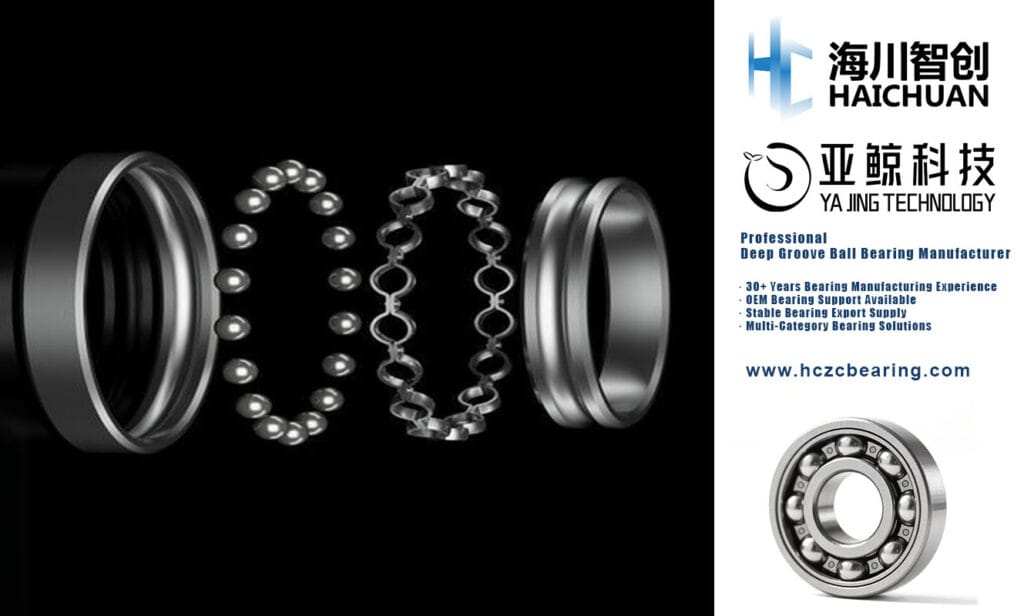
• Deep groove ball bearings are the most versatile type, handling both radial and light axial loads at high speeds
• L10 rating life follows ISO 281: L10 = (C/P)^p × 10⁶ revolutions, where p = 3 for ball bearings and 10/3 for roller bearings
• Precision upgrades from P0 to P4 can increase bearing cost 8–10× — always specify only what your application truly requires
• Customization dimensions (material, precision, noise grade, seal type, cage design, packaging) enable tailored solutions for OEM and non-standard applications
Step 1 — Analyze Operating Conditions
Before opening any catalog, grab a notepad and list every environmental factor your bearing will face. Temperature swings, contamination sources, mounting space, and maintenance intervals all drive downstream decisions in the bearing selection process.
Working Environment
Is the bearing running indoors or outdoors? Will it face dust, moisture, salt spray, or corrosive chemicals? A dusty environment demands sealed bearings (2RS or ZZ) to keep contaminants out. In corrosive settings — food processing, marine, or chemical plants — stainless steel (440C) or ceramic hybrid bearings become essential rather than optional.
Operating Temperature
Temperature directly affects material choice, lubrication, and internal clearance.
• Normal range (−20°C to 120°C): Standard bearing steel with standard clearance (CN) and conventional grease works well.
• High temperature (120°C+): You need high-temperature steel, heat-stabilized rings, high-temp lubricant, and increased clearance (C4 or C5) to accommodate thermal expansion.
• Low temperature (below −20°C): Low-torque grease and special cage materials (such as PEEK or phenolic) prevent stiffening and startup torque spikes.
Installation Constraints
Radial and axial space limitations may force you toward compact designs like needle roller bearings. If frequent disassembly is expected, transition fits simplify removal. Maintenance intervals also shape your sealing and lubrication strategy — longer intervals favor sealed-for-life bearings.
Step 2 — Determine Bearing Loads
If you get the load wrong, nothing else matters. Load direction and magnitude are the first bearing selection criteria that narrow your options. Get these right, and half the catalog eliminates itself.
Radial Loads
Radial loads act perpendicular to the shaft axis — the most common load type in electric motors, fans, and conveyors. Deep groove ball bearings and cylindrical roller bearings are the go-to choices for pure radial loads.
Axial Loads
Axial (thrust) loads run parallel to the shaft. Thrust ball bearings handle pure axial loads, while angular contact ball bearings manage axial loads combined with moderate radial loads.
Combined Loads
When radial and axial forces act simultaneously — typical in gearboxes and vehicle hubs — angular contact ball bearings or tapered roller bearings are the right call. Their geometry is specifically designed to handle mixed loading.
Shock and Impact Loads
Applications with sudden peak loads or variable loading patterns need spherical roller bearings. Their robust design and self-aligning capability absorb shock without catastrophic failure.
Load Direction and Variation
If the load direction rotates relative to the bearing ring, you need interference fits to prevent ring creep. Static load directions allow transition fits. Load fluctuation amplitude also affects your L10 life calculation — higher dynamic loads reduce predicted life exponentially.
| Load Type | Direction | Recommended Bearings |
|---|---|---|
| Radial | Perpendicular to shaft | Deep Groove Ball / Cylindrical Roller |
| Axial (Thrust) | Parallel to shaft | Thrust Bearings / Angular Contact |
| Combined | Mixed radial + axial | Angular Contact / Tapered Roller |
| Heavy Shock | Impact / Variable | Spherical Roller |
Step 3 — Evaluate Speed Requirements
Speed determines heat generation, lubrication demand, and precision requirements. Matching the bearing to your application’s RPM range prevents overheating and premature failure.
Operating Speed
Speed, measured in RPM, is a key constraint that interacts with load, lubrication, and precision. Higher speeds generate more heat, demand better lubrication, and often require tighter precision classes.
Limiting Speed
Every bearing has a limiting speed — the maximum rotational speed it can sustain under a given lubrication method. Ball bearings generally outperform roller bearings at high speeds because their rolling elements are lighter, producing less centrifugal force.
High-Speed vs Low-Speed Applications
• High speed: Deep groove ball bearings, angular contact ball bearings, or ceramic hybrid bearings excel in motors, turbines, and dental handpieces.
• Medium speed: Tapered roller bearings handle gearboxes and automotive applications effectively.
• Low speed, heavy load: Spherical roller and cylindrical roller bearings thrive in mining and heavy machinery where load capacity matters more than RPM.
Step 4 — Calculate Required Bearing Life (L10)
Bearing life is not guesswork. The L10 calculation quantifies how long 90% of identical bearings will survive under a given load, forming the foundation of reliability engineering.
What Is Bearing Life?
Bearing life is defined as the number of revolutions (or operating hours) that 90% of a group of identical bearings can complete before fatigue failure appears on the raceway or rolling elements.
Basic Rating Life (L10)
The ISO 281 standard formula for basic rating life is:
L10 = (C / P)^p × 10⁶ revolutions
Where:
• C = basic dynamic load rating
• P = equivalent dynamic load
• p = 3 for ball bearings, 10/3 for roller bearings
To convert to operating hours: L10h = (C / P)^p × (10⁶ / (60 × n)), where n is RPM.
Service Life vs Rating Life
L10 is a theoretical baseline. Real-world service life depends heavily on lubrication quality, contamination levels, and installation accuracy. The reliability adjustment factor (a₁) lets you trade life for confidence: 90% reliability gives a₁ = 1.0, 95% gives a₁ = 0.62, and 99% gives a₁ = 0.21.
| Application | Target L10 Life |
|---|---|
| Household Appliances | 1,000–2,000 h |
| Electric Motors | 20,000–40,000 h |
| Industrial Gearboxes | 30,000–50,000 h |
| Mining Equipment | 50,000+ h |
Step 5 — Select the Appropriate Bearing Type
With your loads, speeds, and life targets defined, this section of the bearing selection guide helps you match them to the right bearing family. The global deep groove ball bearing market alone was valued at $12.61 billion in 2025, a reflection of how dominant this type is across industries. For a deeper dive into bearing types and detailed load ratings, SKF’s rolling bearing catalog provides comprehensive engineering data.
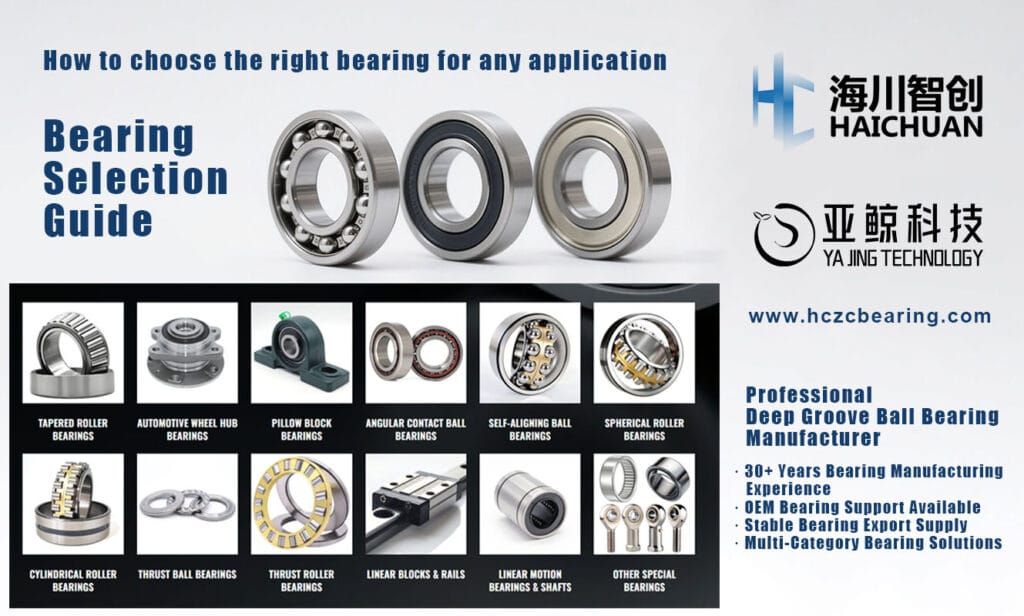
The bearing selection chart below compares nine major bearing types across load capacity, speed, and alignment tolerance to help you narrow your choices at a glance.
Ball Bearings
• Deep Groove Ball Bearings — If you had to pick one bearing type for general-purpose applications, this would be it. High speed, low friction, and capable of handling radial loads plus light axial loads in both directions. Applications: electric motors, fans, water pumps, household appliances.
• Angular Contact Ball Bearings — Engineered for combined loads with a dominant axial component. Available in single or paired configurations for high-speed precision. Applications: machine tool spindles, pumps, high-speed motors.
• Self-Aligning Ball Bearings — Feature two rows of balls with a common sphered raceway, tolerating up to 2–3° of misalignment. Applications: long shafts, conveyor supports, agricultural equipment.
• Thrust Ball Bearings — Designed exclusively for axial loads. They cannot handle radial loads and run at lower speeds. Applications: crane hooks, steering mechanisms, turntables.
Roller Bearings
• Cylindrical Roller Bearings — High radial load capacity with moderate speed capability. Applications: electric motors, steel mills, industrial transmissions.
• Tapered Roller Bearings — Handle combined radial and axial loads with high rigidity. Applications: automotive gearboxes, vehicle wheel hubs, mining conveyors.
• Spherical Roller Bearings — Heavy-duty self-aligning bearings that tolerate misalignment and shaft deflection. Applications: mining equipment, vibrating screens, paper machines.
• Needle Roller Bearings — The most compact radial bearing type, ideal for space-constrained designs. Applications: robotics, automotive transmissions, printing equipment.
• Thrust Roller Bearings — Handle very heavy axial loads at low speeds. Applications: heavy machinery, petroleum drilling equipment, marine propeller shafts.
| Bearing Type | Radial Load | Axial Load | Speed | Misalignment | Typical Application |
|---|---|---|---|---|---|
| Deep Groove Ball | High | Medium | High | Low | Motors, fans, pumps |
| Angular Contact Ball | Medium | High | High | Low | Machine tools, pumps |
| Self-Aligning Ball | Medium | Low | Medium | High | Long shafts, conveyors |
| Thrust Ball | None | High | Low | Low | Crane hooks, turntables |
| Cylindrical Roller | Very High | Low | Medium | Low | Motors, steel mills |
| Tapered Roller | High | High | Medium | Low | Gearboxes, vehicles |
| Spherical Roller | Very High | Medium | Low-Med | High | Mining, conveyors |
| Needle Roller | High | Low | Medium | Low | Robots, gear systems |
| Thrust Roller | None | Very High | Low | Low | Heavy machinery |
Step 6 — Select Bearing Precision and Internal Clearance
Precision and clearance are closely linked — higher precision generally requires tighter clearance control to deliver the expected performance.
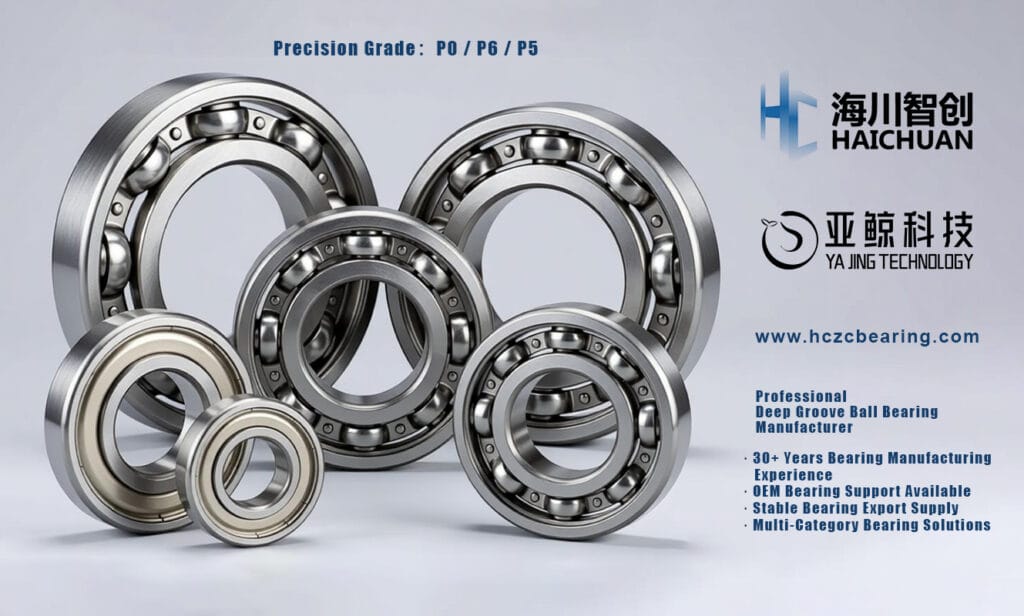
Bearing Precision Classes
Precision determines dimensional accuracy, running accuracy, and noise behavior. The table below maps ISO precision classes (used in Europe and Asia) to their ABEC equivalents (used in North America), helping you cross-reference specifications across international standards.
Cost warning: A P4 bearing can cost 8–10× more than a P0 equivalent. Never over-specify — if your motor runs at 3,600 RPM with standard tolerances, P0 is sufficient.
| Class | ISO | ABEC | Application |
|---|---|---|---|
| P0 | Normal | ABEC-1 | General purpose (motors, fans) |
| P6 | 6 | ABEC-3 | Standard industrial |
| P5 | 5 | ABEC-5 | Precision machinery |
| P4 | 4 | ABEC-7 | Machine tools, servo motors |
| P2 | 2 | ABEC-9 | Ultra-precision (gyros, aerospace) |
When Higher Precision Is Required
Machine tool spindles, robotics joints, servo motors, and precision instruments typically demand P5 or P4. These applications require minimal runout, high rotational accuracy, and controlled vibration.
Internal Clearance Classes
Internal clearance is the amount of free movement of one ring relative to the other before mounting.
| Class | Clearance | Typical Use |
|---|---|---|
| C2 | Smaller than normal | Precision positioning |
| CN | Normal | Standard applications |
| C3 | Greater than normal | Electric motors (most common) |
| C4 | Greater than C3 | High temperature, heavy interference fit |
| C5 | Greater than C4 | Extreme temperature |
Effects of Incorrect Clearance
Too little clearance causes heat buildup, noise, and early failure as thermal expansion consumes all internal play. Too much clearance leads to vibration, reduced accuracy, and abnormal sounds. Remember: both thermal expansion and interference fits reduce effective clearance after installation — always account for these factors.
Step 7 — Determine Fits and Mounting Arrangements
A machine shop once specified P4 precision angular contact bearings for a high-speed spindle but used a transition fit on the inner ring. Within 200 operating hours, the inner ring had crept, scored the shaft journal, and destroyed the bearing arrangement. Fit selection directly affects load distribution, running clearance, and service life. Getting it wrong turns a premium bearing into scrap metal.
Shaft and Housing Fits
• Rotating load (inner ring rotates): Use interference fit on the inner ring (k5 or m5 on the shaft).
• Stationary load (outer ring rotates): Use transition fit on the inner ring (j5 or js5).
• Housing fits: H7 for normal conditions, J7 where axial movement is needed.
Interference vs Transition Fits
Interference fits grip the ring securely but make installation harder and reduce internal clearance. Transition fits are easier to mount and dismount but risk micro-movement (creep) under rotating loads.
Bearing Preload
Preloading removes internal clearance to increase rigidity and rotational accuracy. This is essential for angular contact ball bearings and tapered roller bearings in precision applications. Too much preload, however, generates excess heat and shortens life.
Matched Bearing Arrangements
Back-to-back (DB) is the most common arrangement for machine tool spindles, offering the best rigidity against moment loads.
| Arrangement | Code | Characteristics |
|---|---|---|
| Back-to-Back | DB | High moment stiffness |
| Face-to-Face | DF | Tolerant to misalignment |
| Tandem | DT | Shared axial load capacity |
Step 8 — Choose Lubrication and Sealing Solutions
Think of lubrication and sealing as a package deal. Your seal choice determines your lubrication options, and your lubrication method influences which seals will work. Together, they determine maintenance frequency and how long the bearing actually lasts in service.
Lubrication Methods
Grease-lubricated sealed bearings are essentially maintenance-free for their entire service life. Open bearings require periodic relubrication on a schedule determined by speed, temperature, and contamination levels.
| Method | Speed | Temperature | Maintenance |
|---|---|---|---|
| Grease | Low-Medium | Moderate | Low (sealed bearings) |
| Oil | High | High | Regular (circulation system) |
| Solid/Dry | Low | Extreme | None |
Seal Types
Harsher environments demand tighter seals, which in turn reduce maximum speed. ZZ shields block dust but not water, making them suitable for indoor, dry environments. 2RS rubber seals block both dust and water but limit speed due to contact friction. When speed and contamination protection conflict, consider non-contact labyrinth seals or ceramic hybrid bearings as a compromise.
| Seal Type | Code | Protection | Speed Rating | Removable |
|---|---|---|---|---|
| Open | — | None | Highest | — |
| Metal Shield | ZZ / 2Z | Dust only | High | No |
| Rubber Seal | 2RS / 2RSH | Dust + Water | Medium | No |
Step 9 — Evaluate Special Performance Requirements
Standard catalog bearings cover most applications. But when your application demands more, specialized bearing features become critical differentiators. Whether you need ultra-low noise for a consumer appliance, electrical insulation for a VFD-driven motor, or food-grade compliance for a washdown environment, the right customization across material, precision, noise grade, seal type, cage design, and packaging can make the difference between adequate and exceptional performance.
Low Noise Bearings
Bearing noise is graded Z1 through Z4, with Z4 being the quietest. Electric motors, fans, and household appliances increasingly demand Z3 or Z4 grades to meet consumer noise regulations. HAICHUAN supplies Z3 and Z4 grade low-noise deep groove ball bearings manufactured with controlled raceway finishing and specialized grease.
Low Vibration Bearings
Vibration grades run V1 through V4, with V4 offering the lowest vibration levels. CNC machine tools, servo motors, and precision measurement equipment all benefit from low-vibration bearings that maintain surface finish quality and dimensional accuracy.
Corrosion Resistance
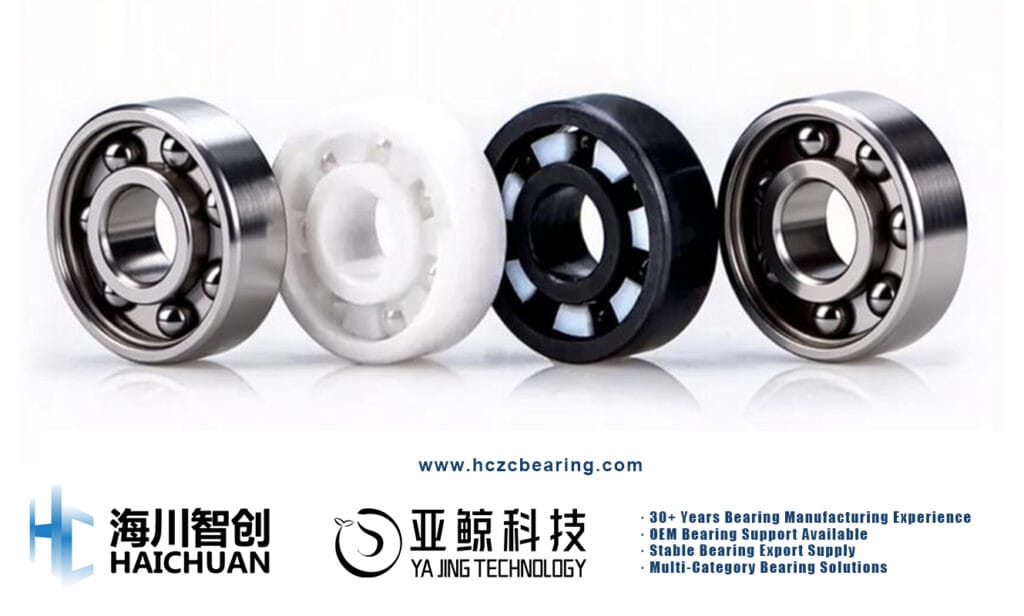
Stainless steel bearings (440C) handle food processing, marine, and chemical environments where standard bearing steel would corrode. For extreme conditions, ceramic hybrid bearings (Si₃N₄ balls) offer superior corrosion resistance alongside high-temperature capability and electrical insulation.
Electrical Insulation
Variable frequency drives (VFDs) can induce stray currents through motor bearings, causing electrical erosion (EDM pitting) on raceways. Hybrid ceramic bearings naturally insulate against this. Coated insulated bearings (aluminum oxide on the outer ring) provide an alternative for wind turbines and railway traction motors.
Food Grade Requirements
FDA-compliant grease, stainless steel or polymer cages, and easy-to-clean designs are mandatory in food and beverage processing. These bearings must withstand frequent washdowns without lubricant washout or corrosion.
Step 10 — Bearing Selection Examples by Industry
A motor OEM in Vietnam was struggling with repeated bearing failures on a line of premium-efficiency motors. The root cause turned out to be a mismatch between C3 clearance and the motor’s actual operating temperature of 95°C. Switching to C4 clearance with 2RS seals and Z3 noise grade eliminated the failures within one production cycle. Real-world bearing selection is where the theory in this bearing selection guide meets the factory floor. Here are practical bearing combinations for common industrial scenarios.
Electric Motor Bearings
Most industrial motors use deep groove ball bearings with C3 clearance, P0–P6 precision, 2RS seals, and Z3 low-noise grade. For high-speed motors, consider paired angular contact ball bearings on the locating end to handle axial loads from magnetic forces.
Gearbox Bearings
A typical industrial gearbox uses tapered roller bearings to handle combined loads on the input and output shafts, paired with deep groove ball bearings on the locating end for axial positioning. The locating-floating arrangement allows thermal expansion without inducing axial loads.
Conveyor Bearings
Bulk material conveyors favor spherical roller bearings or housed units (pillow blocks) that tolerate shaft misalignment. In dusty, heavy-load environments, specify sealed bearings with C3–C4 clearance to accommodate thermal growth while keeping contaminants out.
Agricultural Machinery Bearings
Tapered roller bearings handle the combined loads in wheel hubs and implement drives. Housed insert bearings (with eccentric locking collars) are common for simplicity. Always specify dust seals and wide-temperature grease for seasonal operation.
Automotive Bearings
Wheel hubs use paired tapered roller bearings or hub units. Transmissions combine cylindrical roller bearings (high radial capacity) with deep groove ball bearings (axial positioning). Alternators and generators use sealed deep groove ball bearings for maintenance-free operation.
Mining Equipment Bearings
Spherical roller bearings with C3–C4 clearance dominate mining applications. The combination of heavy shock loads, contamination, and vibration demands steel-pressed cages and sealed designs. Regular relubrication schedules are essential despite seals.
Fans and Blowers
Deep groove ball bearings handle the high-speed, low-load conditions in industrial fans. Specify sealed bearings with high-speed grease and verify rotor balance grade (G2.5 or better) to prevent vibration-induced failures.
Bearing Selection Checklist
Use this bearing selection checklist as a quick reference before finalizing your specification. Each factor corresponds to a step in the bearing selection guide above.
| # | Factor | Key Question |
|---|---|---|
| 1 | Environment | Dust, moisture, corrosion, temperature range? |
| 2 | Load | Radial, axial, or combined? Shock loads? |
| 3 | Speed | Operating RPM? High or low speed? |
| 4 | Life | Target L10 hours? |
| 5 | Bearing Type | Which type fits load + speed + life? |
| 6 | Precision | P0 sufficient or P5/P4 needed? |
| 7 | Clearance | CN, C3, or C4? |
| 8 | Fit | Interference or transition? Shaft/housing tolerance? |
| 9 | Lubrication | Grease or oil? Maintenance interval? |
| 10 | Seal | Open, ZZ, or 2RS? |
| 11 | Special | Noise, vibration, insulation, food grade? |
Need Help Choosing the Right Bearing?
Real-world applications rarely fit neatly into catalog parameters. If your operating conditions fall outside standard ranges, or if you need help working through load calculations, clearance selection, or sealing strategies for a specific application, our engineering team can help.
HAICHUAN’s technical team brings 30+ years of deep groove ball bearing manufacturing experience to your selection challenges. We respond to technical inquiries within 24 hours and can configure custom solutions across six dimensions: material, precision, noise grade, seal type, cage design, and packaging.
Have a bearing selection question? Send us your application parameters and our engineers will help you navigate this bearing selection guide to find the right specification.
FAQ
1. How do I choose the right bearing for my application?
Start by analyzing your operating conditions (environment, temperature, space), then determine load type and magnitude, operating speed, and required L10 life. Match these to a bearing type, then specify precision, clearance, fits, lubrication, and sealing. Follow the 10-step process in this guide for a systematic approach.
2. What is L10 bearing life and how is it calculated?
L10 is the rating life that 90% of identical bearings will reach before fatigue failure. It’s calculated as L10 = (C/P)^p × 10⁶ revolutions, where C is the dynamic load rating, P is the equivalent load, and p is 3 for ball bearings or 10/3 for roller bearings. Convert to hours by dividing by (60 × RPM).
3. When should I use sealed bearings vs open bearings?
Use sealed bearings (2RS) when contamination from dust, moisture, or chemicals is present and maintenance access is limited. Use open bearings when speed requirements exceed seal limits, when you need oil bath lubrication, or when you have a well-controlled clean environment with regular relubrication access.
4. How do I know if I need C3 or C4 clearance?
C3 is the standard choice for electric motors and most applications where normal thermal expansion occurs. Choose C4 when operating temperatures are high (above 120°C), when heavy interference fits reduce internal clearance, or in applications with significant heat generation like mining and heavy machinery. This bearing selection guide recommends verifying clearance after accounting for thermal expansion and interference fit reductions.
5. What are the most common bearing selection mistakes?
The most common bearing selection mistakes include:
• Over-specifying precision (paying P4 prices for P0 applications)
• Ignoring thermal expansion effects on internal clearance
• Mismatching seal types to environmental conditions
• Underestimating load fluctuations in L10 calculations
• Neglecting the interaction between fits and internal clearance
6. Can I customize bearings for non-standard applications?
Yes. HAICHUAN offers a 6-dimension customization matrix covering material, precision, noise grade, seal type, cage design, and packaging. Whether you need food-grade stainless steel bearings with FDA grease or Z4 low-noise bearings for a premium motor, OEM and ODM customization is available with 30+ years of deep groove ball bearing manufacturing expertise.