Deep Groove Ball Bearing Complete Guide: Material, Precision, Seal & Series
Materials and Cage Options
| Cage Type | Material | Best For |
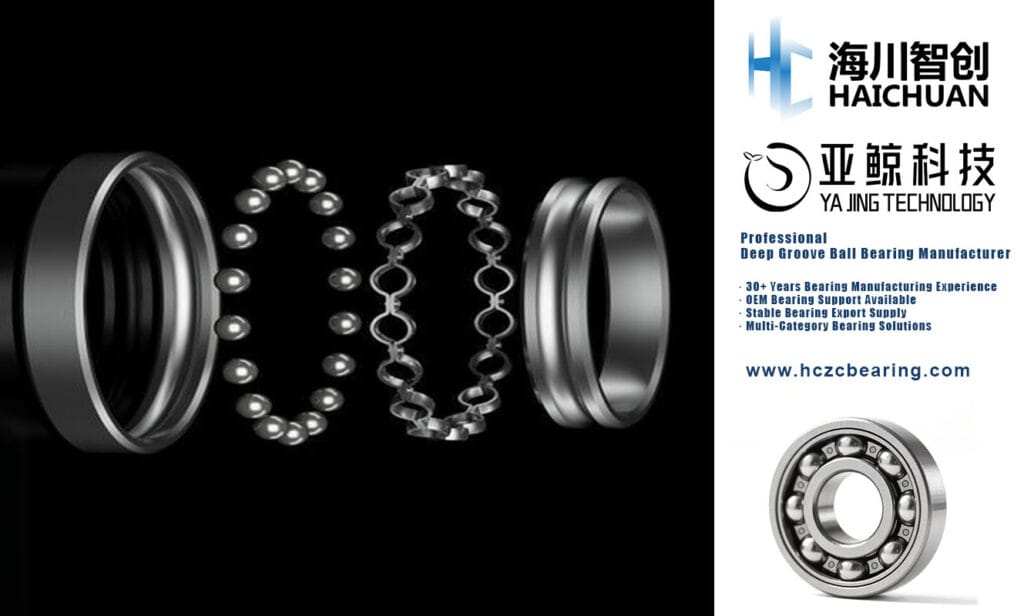
| Stamped steel cage (J) | steel | General industrial use, high temperatures |
| Brass cage (M) | Machined or stamped brass | High shock loads, vibration, heavy industrial |
| Polyamide cage (TN) | Injection-molded nylon (such as PA66) or glass fiber reinforced nylon | Quiet running, low weight, not for very high temperatures |
| Ring Material | Material |
| High-carbon chromium bearing steel (GCr15 / 100Cr6 / SUJ2) | The standard material. This is the global standard for through-hardened bearing rings and provides a long service life in the vast majority of applications. |
| Carbon Steel | Lower cost, suitable for low-speed and light-load conditions, shorter service life. |
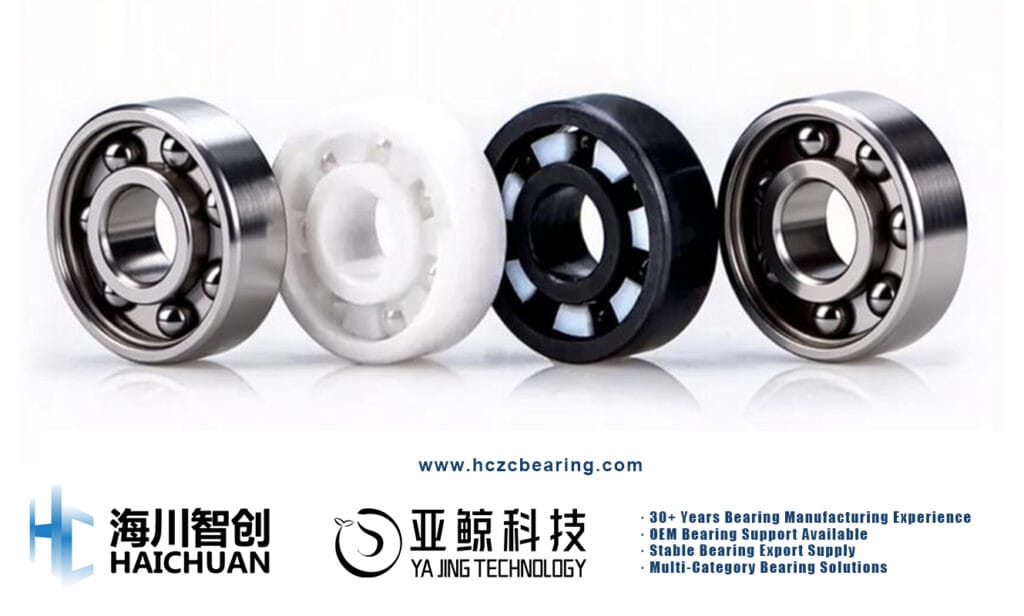
| Stainless steel (AISI 440C) | For food processing, medical, marine, and chemical applications. |
| Ceramic-hybrid (Si3N4 balls + steel rings) | For very high speeds, dry running, or non-magnetic applications. |
| Full Ceramic (Si3N4 / ZrO2 balls + ceramic rings) | For extreme temperatures, highly corrosive environments, or strict electrical insulation requirements. |
| Suffix (Seal/Shield Type) | Meaning | Practical Effect |
| 2Z, ZZ | Two metal shields | Higher speed, lower friction, not dust-tight |
| 2RS, DU | Two rubber contact seals | Dust and water resistant, slightly lower top speed |
| 2RZ | Two rubber non-contact seals | Better sealing than 2Z, faster than 2RS |
| None (Open) | Open bearing, no shields or seals | Lowest friction, highest speed, requires external lubrication and sealing |
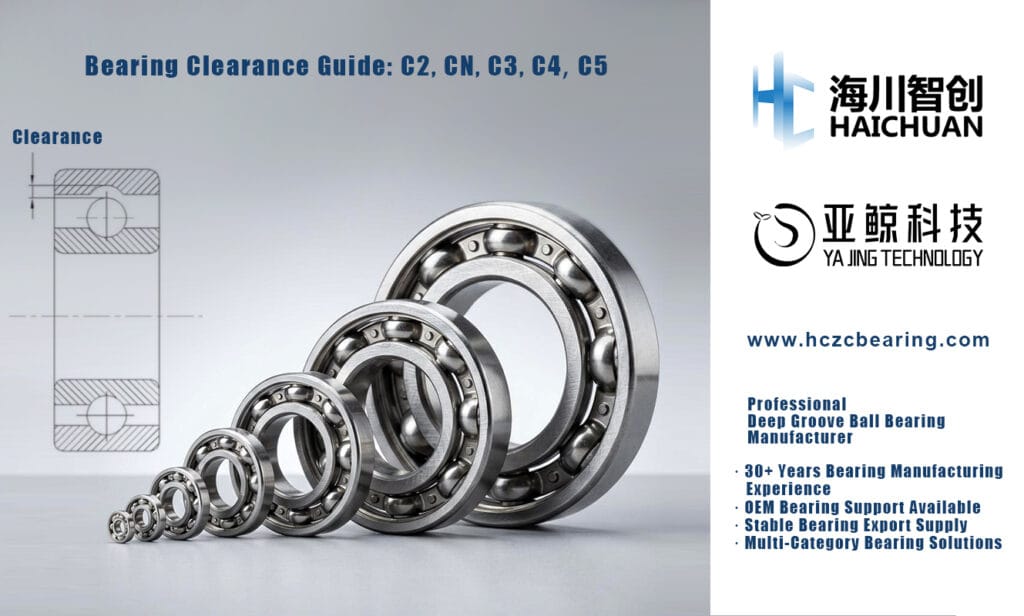
| Suffix(Clearance Code) | Meaning | Practical Effect |
| C1 | Clearance Group 1 (Extra Small) | Extremely small clearance. Used in miniature motors or precision instruments requiring exceptionally high rotational accuracy and minimal vibration. |
| C2 | Clearance Group 2 (Small) | Smaller than standard clearance. Suitable for applications requiring high rotational accuracy and strict control over axial runout. |
| CN / Normal | Normal Clearance (Standard) | The default standard clearance. It is usually omitted from the bearing designation or packaging (e.g., a bearing marked “6204” without a suffix defaults to CN). Suitable for most conventional operating conditions. |
| C3 | Clearance Group 3 (Loose/Large) | Larger than standard clearance. Widely used when there is a tight interference fit between the inner ring and the shaft, or in high-temperature environments where the inner ring expands and reduces clearance. |
| C4 | Clearance Group 4 (Extra Large) | Even larger clearance. Used in heavy-duty applications, high shock loads, or extreme environments with large temperature differentials between inner and outer rings (e.g., steel mills, paper-making machinery). |
| C5 | Clearance Group 5 (Max Large) | The largest standard clearance. Rarely used, reserved for specialized ultra-high temperature applications or extreme heavy industries. |
| Suffix (precision) | Meaning | Practical Effect |
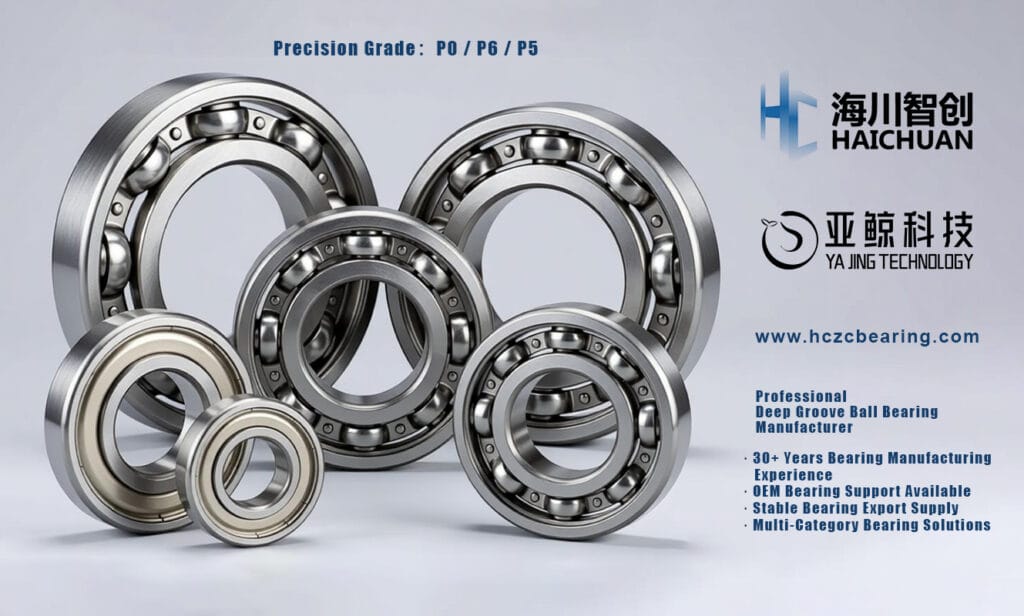
| P0 | Standard precision | General industrial use |
| P6 | Higher precision | Machine tool spindles, pumps |
| P5 | High precision | Machine tools, high-speed spindles |
| …… | …… | …… |