Bearing Seals Guide: Types, Functions and Selection Tips
Bearing seals are among the smallest yet most decisive components inside a rolling bearing). They sit at the boundary between the rotating inner ring and the outside world, forming a barrier that keeps lubricant in and contaminants out. For procurement engineers and maintenance teams, the choice between an open bearing, a ZZ shielded bearing, and a 2RS sealed bearing often decides whether a bearing runs for 20,000 hours or fails inside 2,000. This guide explains bearing seal structures, how each type performs under real operating conditions, and—most importantly—how to select the right seal for your application. If you have ever asked “Open, ZZ, or 2RS—which one do I need?”, the answer is below.
What Are Bearing Seals?
A bearing seal is a structural feature integrated into a bearing’s side faces, engineered to perform four jobs at once:
• Block contaminants — keep dust, dirt, and metal particles from reaching the raceways.
• Retain lubricant — stop greasy film from leaking out of the bearing cavity.
• Protect the grease — maintain the lubricating film that separates rolling elements from raceways.
• Extend life — reduce wear, corrosion, and premature fatigue.
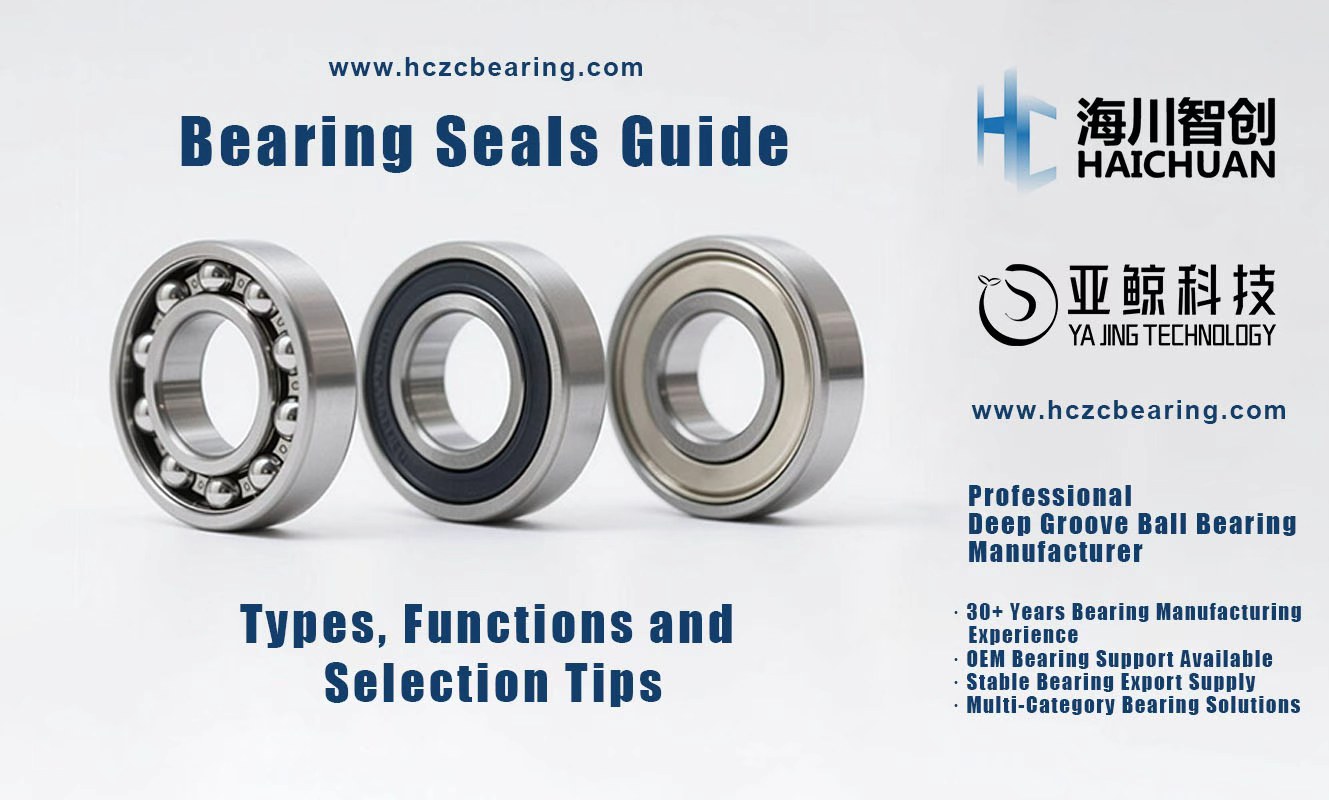
A common point of confusion is the difference between a seal and a shield. A shield (such as a ZZ steel plate) is a non-contact cover that sits close to the ring but does not touch it. A seal (such as a 2RS rubber lip) makes physical contact with the ring. That single distinction drives the friction, speed, and protection trade-offs covered throughout this guide.
Why Are Bearing Seals Important?
Bearing seals do more than close the gap between the inner and outer rings. They control how long a bearing lasts, how much maintenance it needs, and how reliably it performs in harsh environments. The four reasons below explain why the right seal is the cheapest insurance in any rotating assembly.
Contamination Protection
Rolling bearings fail early primarily because hard particles enter the contact zone and score the finely finished raceways. Even a few microns of debris can initiate pitting that cascades into spalling. Seals form the first and most cost-effective line of defense against dust, airborne dirt, and circulating metal particles in gearboxes or mills.
Lubricant Retention
Grease is a consumable. Without a seal, centrifugal force and vibration gradually throw lubricant out of the bearing, leaving the rolling elements to run dry. A proper seal keeps the grease where it belongs, enabling longer relubrication intervals.
Moisture Protection
Water and humidity are silent killers. They wash away additive packages in grease and promote rust on rings and cages. Rubber-sealed designs (RS / 2RS) stop liquid ingress far more effectively than open or shielded types.
Extended Bearing Life
Combine the three benefits above and the result is predictable: sealed bearings in the right environment deliver a multiple of the service life of an unprotected equivalent. For designers, seals are the cheapest insurance available.
Types of Bearing Seals
This is the core of the guide. Four families cover the vast majority of industrial and automotive applications. Most appear in deep groove ball bearings; for the full type landscape see our Bearing Types Guide.
Open Bearings
Structure. No sealing element at all—the rolling elements and raceways are fully exposed.
Advantages.
• Lowest friction and heat generation of any configuration.
• Highest allowable speed (no seal drag).
• Easy to relubricate or flush in place.
Disadvantages.
• Poor contamination and moisture protection.
Applications. Gearboxes with dedicated oil baths, oil-lubricated systems, and clean industrial machinery where the environment is already controlled.
Shielded Bearings (Z / ZZ)
Structure. A stamped steel plate (one side = Z, both sides = ZZ) pressed into the outer ring, with a small radial gap to the inner ring.
Advantages.
• Good dust protection at the gap.
• Higher speed capability than rubber-sealed types.
Disadvantages.
• Limited water resistance—liquid can pass through the non-contact gap.
Applications. Electric motors, fans, and pumps operating in relatively clean, dry conditions.
Rubber Sealed Bearings (RS / 2RS)
Structure. A molded rubber lip (typically NBR) seated in the outer ring and pressing against the inner ring shoulder. RS = one side, 2RS = both sides.
Advantages.
• Excellent dust protection.
• Excellent moisture protection.
• Effectively maintenance-free for the bearing’s design life.
Disadvantages.
• Slightly higher friction and heat, which caps maximum speed.
Applications. Agricultural machinery, conveyors, and any outdoor or washdown equipment.
Non-Contact Seals
Structure. A rubber or labyrinth profile shaped so it seals without touching the rotating ring.
Characteristics. They capture most of the protection of a contact seal while preserving much of the speed headroom of a shield—an engineered compromise.
Applications. High-speed machinery and precision equipment where both cleanliness and RPM matter.
Bearing Seal Materials
The rubber compound determines temperature range, chemical resistance, and cost—covered in depth in our Bearing Materials Guide.
NBR (Nitrile Rubber)
The industry default. NBR is cost-effective, oil-resistant, and performs well from roughly −40 °C to +120 °C. It suits the majority of general-purpose sealed bearings.
FKM (Viton)
A fluoroelastomer built for punishment. FKM resists high temperatures (up to ~200 °C) and aggressive chemicals, making it the choice for engines, compressors, and chemical processing.
PTFE
Polytetrafluoroethylene seals offer extremely low friction and outstanding chemical resistance, with temperature capability beyond 260 °C. They are premium components used where friction loss or chemical attack cannot be tolerated.
Open vs Shielded vs Sealed Bearings
The single most-searched comparison in the seal world, summarized in one table:
Read it top to bottom and the pattern is clear: as protection rises, speed headroom falls. The “right” answer is simply the lowest-protection option your environment can tolerate.
| Feature | Open | ZZ | 2RS |
|---|---|---|---|
| Dust Protection | Poor | Good | Excellent |
| Water Resistance | Poor | Limited | Excellent |
| Speed Capability | Highest | High | Medium |
| Maintenance | Required | Low | Minimal |
ZZ vs 2RS Bearings
This is the highest-volume long-tail query in the seal category, and the one most likely to convert into an inquiry.
What Is ZZ?
ZZ denotes a bearing sealed on both sides with stamped steel shields. The shields do not touch the inner ring, so there is no sealing friction—only a narrow gap that blocks coarse dust.
What Is 2RS?
2RS denotes a bearing sealed on both sides with rubber lips that press against the inner ring. The contact creates a positive barrier against both dust and water.
Key Differences
• Dust Protection: ZZ is good; 2RS is excellent.
• Water Resistance: ZZ is limited; 2RS is excellent.
• Speed: ZZ runs faster; 2RS is speed-capped by seal drag.
• Friction: ZZ is lower; 2RS is marginally higher.
Which One Should You Choose?
Choose ZZ for clean, dry, higher-speed duty such as electric motors and fans. Choose 2RS for wet, dusty, or outdoor duty such as conveyors, agriculture, and washdown environments. When in doubt about moisture, choose 2RS.
Bearing Seals for Different Applications
B2B buyers usually shop by industry, not by spec sheet. Recommended starting points:
• Electric Motors → ZZ bearings (clean, high speed, low friction).
• Agricultural Machinery → 2RS bearings (dust, mud, washdown).
• Mining Equipment → heavy-duty sealed bearings (extreme contamination).
• Conveyor Systems → 2RS bearings (outdoor, dusty, continuous run).
• Food Processing Equipment → stainless steel construction with 2RS seals (hygiene, washdown, corrosion resistance).
How to Select the Right Bearing Seal
Selection is a four-variable problem—extending the framework in our Bearing Selection Guide. Rank your constraints in this order:
• Operating Environment — Is there dust, water, or chemical exposure? More hostile media demands a contact seal and a higher-grade material.
• Speed Requirements — High RPM favors open or ZZ; low-to-medium RPM can absorb 2RS drag.
• Maintenance Requirements — Can the line be stopped for relubrication, or must the bearing be maintenance-free?
• Service Life Expectations — Longer life targets justify the small premium of a quality sealed bearing.
At HAICHUAN, seal selection is treated as one dimension of a broader engineering promise: our 6-dimensional customization matrix—covering material, precision, noise, sealing, cage, and packaging—lets us specify the exact seal type, compound, and clearance your duty cycle demands, rather than forcing a catalog compromise.
Common Bearing Seal Failures
Understanding how seals fail helps you prevent the bearing failure that follows.
Seal Wear
The rubber lip gradually wears against the ring shoulder, widening the gap until contaminants sneak in. Accelerated by abrasive dust and misalignment.
Seal Hardening
Heat and age drive the elastomer to lose plasticizers, becoming brittle and cracked. Hardened seals no longer follow the ring, opening a leak path.
Lubricant Leakage
A damaged or displaced seal lets grease escape, starving the bearing. Often visible as grease stains around the housing.
Contamination Ingress
Once a seal is compromised, dust and water enter freely, scoring raceways and rusting surfaces—the fast track to catastrophic failure.
Bearing Seal Selection Chart
A quick-reference decision table for common duty cycles:
| Working Condition | Recommended Seal |
|---|---|
| Clean & High Speed | Open |
| Dusty Environment | ZZ |
| Wet & Dusty | 2RS |
| Chemical Exposure | FKM / PTFE |
| Food Industry | Stainless + 2RS |
Conclusion
Bearing seal selection comes down to five factors: Environment, Speed, Maintenance, Service Life, and Cost. Start with the least protective option your application can survive, then step up to ZZ or 2RS—or to FKM/PTFE and stainless construction—as contamination and moisture rise. The right seal is not the most expensive one; it is the one matched to the job.
Need a seal specified for a demanding duty cycle? The engineering team at HAICHUAN can configure the seal, material, and clearance through our 6-dimensional customization matrix and deliver deep-groove ball bearings built for your exact operating conditions. Contact our bearing specialists for a tailored selection recommendation.
FAQ
1. What is the purpose of a bearing seal?
A bearing seal blocks contaminants, retains lubricant, and protects the grease film, all of which extend bearing service life.
2. What is the difference between ZZ and 2RS bearings?
ZZ uses non-contact steel shields (good dust protection, higher speed); 2RS uses contact rubber lips (excellent dust and water protection, lower speed).
3. Are sealed bearings maintenance-free?
Rubber-sealed (2RS) bearings are effectively maintenance-free for their design life, as the factory grease is retained and protected.
4. Which bearing seal is best for wet environments?
A 2RS rubber-sealed bearing offers the best moisture protection among standard configurations.
5. Can bearing seals be replaced?
In most standard bearings the seal is integral and not field-replaceable; the bearing is replaced as a unit. Custom or split-housing designs may allow seal service.
6. Do seals affect bearing speed?
Yes. Contact seals (2RS) add drag and cap maximum speed; non-contact shields (ZZ) and open bearings run faster.
7. What seal material is best for high temperatures?
FKM (Viton) handles up to ~200 °C and PTFE beyond 260 °C, both far exceeding standard NBR.
8. How do I choose the right bearing seal?
Match the seal to your environment, speed, maintenance access, and life target—lowest protection your duty cycle can tolerate, stepping up to 2RS or specialty materials when moisture or chemicals appear.