Bearing Materials Guide: 5 Types Compared with Selection Tips
Complete Bearing Materials Guide: How to Choose the Right Material for Your Application
A bearing rated for 20,000 hours can fail in 200 — simply because the wrong material was specified. Bearing materials determine load capacity, speed limits, corrosion resistance, and service life. Whether you’re sourcing deep groove ball bearings for a gearbox or corrosion-proof units for a food line, material choice makes or breaks your design. We’ll walk through each option — and where it breaks down.
Quick Comparison: 5 Bearing Materials at a Glance
The following table compares five bearing materials across seven critical properties.
| Property | Bearing Steel (Chrome) | Carbon Steel | Stainless Steel (440C) | Ceramic (ZrO₂/Si₃N₄) | Plastic (PTFE/PEEK) |
| Load Capacity | Highest | Moderate | High (15–20% lower) | Moderate | Low |
| Max Speed | High | Moderate | Moderate | Very High (+30–50%) | Moderate |
| Max Temperature | ~120 °C | ~120 °C | ~300 °C | 800 °C+ | ~250 °C |
| Corrosion Resistance | Poor | Poor | Good–Excellent | Excellent | Excellent |
| Magnetic | Yes | Yes | Mostly yes; 316: No | No | No |
| Relative Cost | Low (baseline) | Lowest | Moderate | High (10–20×) | Low–Moderate |
| Best For | General industrial | Light-duty, cost-sensitive | Wet/corrosive | High-speed, high-temp | Clean, low-load |
Key Takeaways
– Chrome steel (52100) is the most common bearing material — ideal for general loads at the lowest cost.
– Stainless steel sacrifices ~15–20% load capacity for corrosion resistance; 440C for hardness, 316 for max corrosion protection.
– Ceramic bearings run 30–50% faster and survive 800 °C+, but cost 10–20× more than steel.
– Plastic bearings are self-lubricating and non-magnetic — perfect for clean rooms, but only for light loads.
– The “best” bearing material is the one matched to your environment, not the one with the highest specs.
Bearing Steel (Chrome Steel)
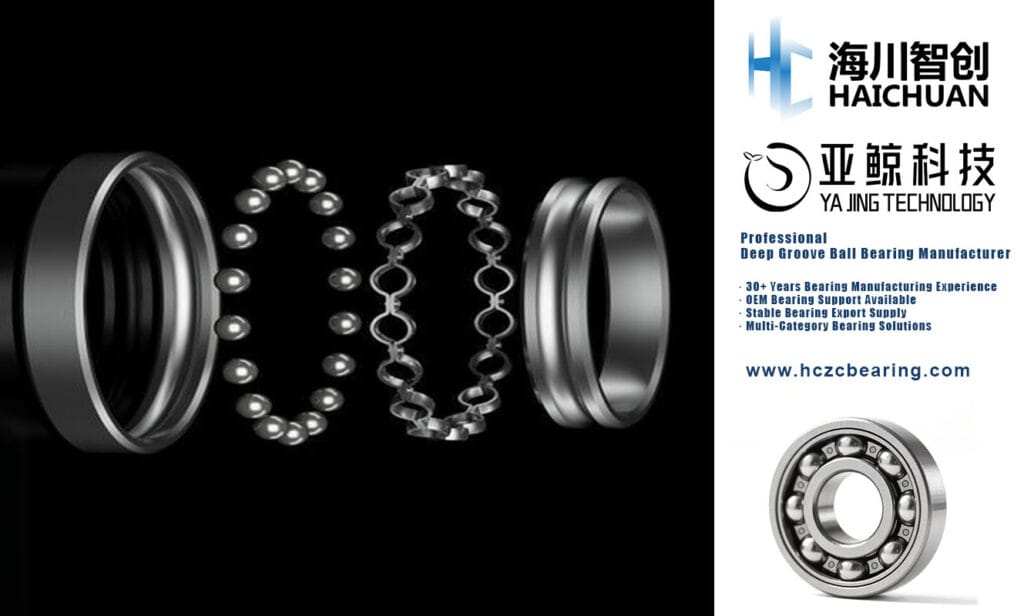
Of all bearing materials, chrome steel is what 90% of the world’s bearings are made from. The common grade crosses standards: GCr15 / 52100 / SUJ2 / 100Cr6 (ASTM A295 standard). After heat treatment it reaches HRC 60–64, the highest load capacity of any standard bearing material.
Dry conditions, moderate temps? Nothing beats the price-to-performance ratio. Wet environments? It rusts in weeks. Its ceiling is ~120 °C, with zero corrosion resistance.
Pros: Highest load rating; lowest cost; widest availability across tapered roller bearings for heavy agricultural loads and standard deep groove designs.
Cons: Poor corrosion resistance; limited to ~120 °C.
Typical Applications: Electric motors, gearboxes, automotive wheel hubs, agricultural machinery.
Carbon Steel Bearings
Carbon steel bearings use low- or medium-carbon steel without chromium. They reach HRC 55–60 — softer than chrome steel — limiting them to light-to-moderate loads. Their advantage: lowest cost of any bearing option.
One packaging plant saved $0.40 per bearing by switching to carbon steel across 800 rollers. Six months later, premature wear caused 12 unplanned stoppages — each over $5,000. A $320 saving became a $60,000 lesson. They switched back to chrome steel within the year.
Pros: Lowest cost; adequate for light-duty use.
Cons: Lower hardness; shorter life; still prone to corrosion.
Typical Applications: Conveyor rollers, agricultural implements, low-cost consumer appliances, light-duty casters.
Stainless Steel Bearings
When chrome steel rusts — and it will, in any wet environment — you switch to stainless. The cost: 15–20% less load capacity at the same size. A food processing line running 16-hour shifts with daily washdowns found chrome steel bearings corroding within months; 440C stainless lasted 3–5 years in the same conditions.
Among stainless bearing materials, two grades dominate. 440C is martensitic, retaining high hardness (HRC 58–62) with moderate corrosion resistance — suitable for damp, not fully immersed environments. 316 (austenitic) provides excellent corrosion resistance, even in saltwater, but cannot be hardened, resulting in much lower load capacity.
Pros: Corrosion resistance from moderate (440C) to excellent (316); washdown-compatible.
Cons: Lower load capacity; higher cost; 316 has limited hardness.
Typical Applications: Food processing, medical devices, marine hardware, chemical pumps.
Ceramic Bearings
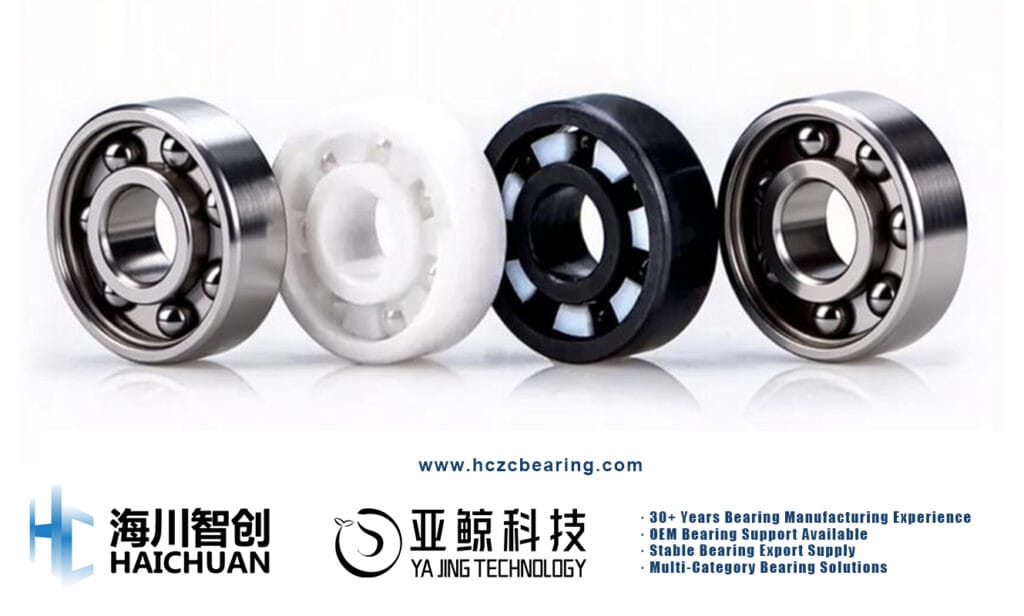
A dental handpiece spinning at 400,000 RPM would destroy a steel bearing in weeks. Silicon nitride handles that speed — and stays cool. Ceramic bearing materials come in two forms: hybrid (steel rings, ceramic Si₃N₄ balls) and full ceramic (rings and balls of ZrO₂ or Si₃N₄). Hybrid balances performance and cost; full ceramic survives where metal can’t — 800 °C, saltwater, MRI fields.
Ceramic balls are 30–50% lighter than steel, enabling higher speeds. They are non-magnetic and resist virtually every chemical. The catch: 10–20× higher cost, and full ceramic is brittle under impact.
Pros: Exceptional speed and temperature; non-magnetic; chemically inert.
Cons: Very high cost; brittle under shock; limited large sizes.
Typical Applications: High-speed spindles (angular contact ball bearings designed for high-speed precision), MRI equipment, semiconductor manufacturing, dental handpieces.
Plastic & Polymer Bearings
Plastic bearings use engineered polymers — PTFE for ultra-low friction, PEEK for high-temp chemical resistance, POM for dimensional stability, Nylon for general light loads. The real advantage: self-lubrication — no grease, no contamination, zero maintenance. In a semiconductor cleanroom, even a drop of grease is contamination. PEEK bearings run dry — zero lubricant, zero particles.
They’re lighter than any metal bearing and inherently non-magnetic. But they can’t carry heavy loads — and under sustained weight, they creep. Not for demanding jobs.
Typical Applications: Food conveyors, office equipment, cleanroom robotics, packaging machinery.
Bearing Material Selection Guide
Narrow it down in five decisions, aligned with SKF’s official bearing selection criteria:
1.Define the environment. Dry, humid, or corrosive? Washdown requirements?
2.Determine load. Heavy or shock loads favor chrome steel; light loads open the door to plastics.
3.Check speed and temperature. High speed or extreme heat points toward ceramics.
4.Consider magnetic/electrical needs. Non-magnetic rules out steel — consider ceramics or polymers.
5.Calculate total cost of ownership. A cheap bearing that fails frequently costs more than a premium one that lasts.
Industry Quick Reference — for HAICHUAN’s industry-specific bearing solutions:
| Industry | Recommended Material | Why |
| Automotive | Chrome Steel | Highest load, cost-effective |
| Food & Beverage | Stainless Steel (440C/316) | Corrosion resistance, washdown-ready |
| Medical | Stainless Steel / Ceramic | Sterilization, non-magnetic options |
| Marine | Stainless Steel (316) | Saltwater corrosion resistance |
| General Industrial | Chrome Steel | Best balance of load, speed, cost |
| Cleanroom / Semiconductor | Ceramic / Plastic | Non-contaminating, self-lubricating |
Frequently Asked Questions (FAQ)
1.What is the most common bearing material?
Chrome steel is the most common bearing material, used in over 90% of industrial and automotive applications. The 52100 / GCr15 / SUJ2 / 100Cr6 grade delivers HRC 60–64 hardness, the highest load capacity, and the lowest cost — it’s what you’ll find in nearly every motor, gearbox, and wheel hub on the planet.
2.Are ceramic bearings better than steel?
Not automatically. Ceramics crush steel on speed, heat, and corrosion — but at 10–20× the price, and they shatter under impact. For most general loads at moderate speeds, steel wins on practicality.
3.What is the difference between bearing steel and stainless steel?
Bearing steel maximizes load capacity; stainless steel maximizes corrosion resistance. Bearing steel contains ~1.5% chromium for hardenability (HRC 60–64) — but rusts easily. Stainless steel has 12–19% chromium for corrosion resistance but sacrifices 15–20% load capacity. Use bearing steel for dry, high-load applications; stainless for wet or corrosive environments.
Conclusion
Chrome steel handles 90% of applications because it’s cheap and strong. The other 10% — wet, hot, fast, or clean — needs stainless, ceramic, or polymer. Among all bearing materials, there is no single winner. Pick the material that survives your worst operating day — not your average one. That’s the bearing that actually lasts.
Need help choosing? HAICHUAN’s OEM manufacturing capabilities cover the full material range — from chrome steel to specialty ceramics — with customization and free technical consultation. Contact HAICHUAN →