Bearing Types Guide: Different Types of Bearings and Their Applications
Pick the wrong bearing types and you may not notice the mistake until a production line goes down. Selection—not the component itself—is where most rotating-equipment reliability is won or lost. SKF’s field data links roughly 16% of early bearing failures to poor fitting and mounting alone (SKF mounting-failure analysis), and the bill shows up as unplanned downtime, emergency freight, and lost production.
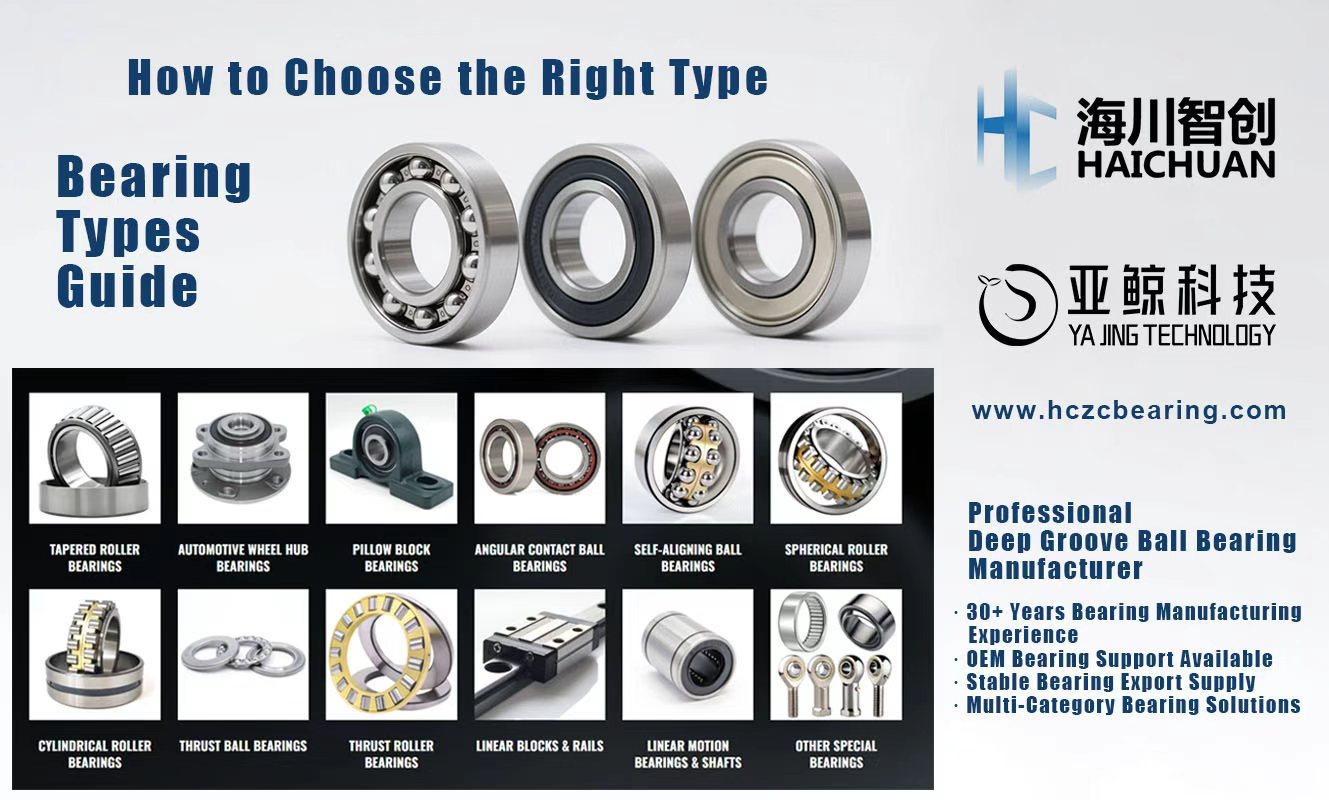
This bearing types guide walks you through the major types of bearings and their uses, from deep groove ball bearings to spherical roller bearings, and shows you how to choose bearing type with confidence. You’ll get a clear classification framework, an at-a-glance bearing types comparison, and practical selection rules you can apply on the next RFQ. New to specification? Start with our step-by-step bearing selection guide for the full method.
What Are Bearings?
A bearing is a precision machine element that sits between a rotating shaft and a stationary housing. State it plainly: a bearing constrains motion to one axis, carries load, and lets parts turn with as little friction as possible.
In practice, that translates into three measurable gains for any rotating machine:
• Lower friction — rolling elements replace sliding contact, cutting energy loss and heat.
• Higher efficiency — less drag means more of the input power reaches the output.
• Longer life (higher MTBF) — reduced wear extends service intervals and mean time between failures.
For procurement and MRO teams, the bearing is rarely the line item that gets scrutiny—but it should. A single misapplied bearing can idle a production line at a cost that dwarfs the part’s price many times over. Across a plant full of motors, pumps, and conveyors, those small choices add up to a large share of the lifecycle budget. Selecting well is not a specification detail; it is a reliability strategy. (See the rolling-element bearing overview for the underlying physics.)
How Are Bearings Classified?
Before comparing specific bearing types, it helps to place every bearing on a common map. Engineers typically classify bearings along three independent axes:
• By rolling element — ball bearings use spheres; roller bearings use cylinders, cones, or barrels. Balls suit high speed and lower load; rollers suit heavy load and lower speed.
• By load direction — radial bearings carry loads perpendicular to the shaft; thrust bearings carry loads parallel to the shaft; combined-load types handle both.
• By alignment capability — rigid bearings demand precise shaft/housing alignment; self-aligning bearings tolerate misalignment and deflection.
Here is the classification tree at a glance:
These axes interact. A deep groove ball bearing is a ball-type, mainly radial, rigid bearing. A spherical roller bearing is a roller-type, combined-load, self-aligning bearing. Keep the three axes in mind—we’ll return to them in the selection section, and internal clearance (covered in our bearing clearance guide) is the fourth variable that fine-tunes fit.
Bearings
- Ball Bearings
- Deep Groove Ball radial, versatile
- Angular Contact Ball combined load, high speed
- Self-Aligning Ball misalignment tolerant
- Thrust Ball axial only
- Roller Bearings
- Cylindrical Roller high radial
- Tapered Roller radial + axial
- Spherical Roller heavy + self-aligning
- Needle Roller compact, high radial
- Thrust Roller axial, heavy
Ball Bearings
Balls roll on point contact, so ball bearing types stay low-friction and run at high limiting speeds. The trade-off is load capacity: a small contact patch concentrates stress, so ball bearings generally carry less load than an equivalent-size roller bearing. They are the default for electric motors, fans, pumps, and most high-speed spindles.
Deep Groove Ball Bearings
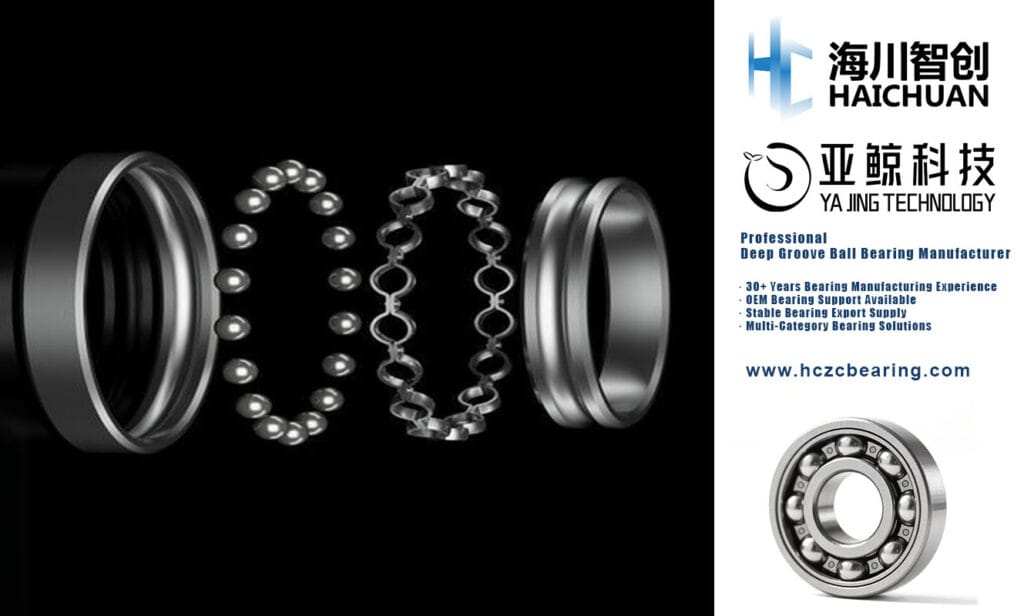
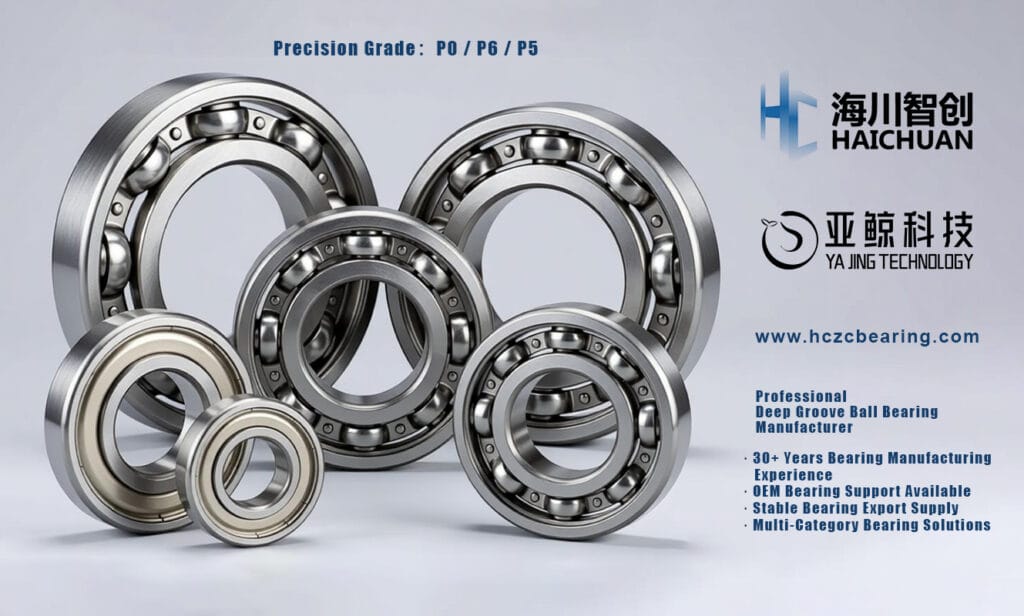
The deep groove ball bearing is the workhorse of every rotating assembly—and the most-produced bearing on earth, roughly 60–70% of all rolling bearings made each year. Its deep, continuous raceway grooves let it carry radial loads and moderate axial loads in both directions, while running quietly at high speed.
Three ISO series cover most needs:
• 6000 series — extra-light; smallest cross-section for a given bore.
• 6200 series — light; the most common general-purpose choice.
• 6300 series — medium; higher load capacity, larger section.
• 6400 series — heavy; maximum load capacity and the largest cross-section, for demanding industrial duty.
You’ll find them in electric motors, household appliances, water pumps, HVAC fans, and power tools—anywhere a reliable, low-cost, low-maintenance rotating support is needed.
🔑 Smart Default
When a design calls for a standard radial support at moderate load and high speed, start with a deep groove ball bearing. It is the sensible “smart default”: broadly available, inexpensive, and proven across decades of service. Reach for a specialty type only when a specific load, speed, or alignment constraint justifies it.
A mid-size appliance OEM was fielding a steady stream of noise-complaint returns on one blender-motor line. Root-cause analysis pointed not to the motor winding but to bearing acoustics. Switching the standard units to HAICHUAN ZV2 low-noise deep groove ball bearings—a tighter precision grade with controlled cage and grease—cut the complaint rate sharply within a single production quarter, with no change to the motor’s envelope or cost target.
Explore HAICHUAN deep groove ball bearings (6000 / 6200 / 6300 / 6400 series) for your application.
Angular Contact Ball Bearings
Angular contact ball bearings are built for combined loads. The raceway geometry creates a contact angle (commonly 15°, 25°, or 40°), so the bearing handles radial load plus a substantial axial load in one direction—and, in paired arrangements, in both. They suit machine-tool spindles, precision pumps, and gearboxes where stiffness and speed matter.
Browse angular contact ball bearings for paired and duplex arrangements.
Self-Aligning Ball Bearings
Self-aligning ball bearings have two rows of balls and a spherical outer raceway, letting the inner assembly tilt slightly to accommodate shaft deflection or housing misalignment. They are the pragmatic choice for long shafts, textile machinery, and conveyors where perfect alignment is hard to guarantee.
See self-aligning ball bearings for deflection-tolerant designs.
Thrust Ball Bearings
Thrust ball bearings are purpose-built for axial loads. They separate shaft and housing washers with a ball cage and handle purely axial forces—ideal for turntables, low-speed vertical shafts, and crane hooks. They are not suited to radial load or high speed.
Standard single-direction series include 51100, 51200, and 51300 (shaft diameters from roughly 10 mm to 100+ mm); double-direction types stack a second ball cage for reversible axial thrust. Because the load path is purely axial, they run at moderate speed only and collapse if any radial force is applied—so pair them with a radial bearing whenever the shaft also sees side load.
Find thrust ball bearings for vertical-shaft duty.
Roller Bearings
Swap the spheres for cylinders, cones, or barrels and the physics change. Roller bearing types use line contact, which spreads load over a larger area, so they carry substantially higher loads than same-size ball bearings—at the cost of higher friction and lower limiting speed. They dominate heavy-industrial and shock-load applications.
Cylindrical Roller Bearings
Cylindrical roller bearings excel at high radial loads and can reach high speeds thanks to their low-friction roller geometry. Many designs allow one ring to float axially, accommodating thermal shaft growth. They are common in gearboxes, electric motors, and rolling-mill supports.
View cylindrical roller bearings for high-radial duty.
Tapered Roller Bearings
Tapered roller bearings use conical rollers that sit between tapered raceways, so they carry radial and axial loads simultaneously—and in both directions when mounted in pairs. Their combined-load capability makes them standard in automotive wheel hubs, agricultural machinery, and gearbox pinions.
Explore tapered roller bearings for combined-load designs.
Spherical Roller Bearings
When the load is brutal, spherical roller bearings are the type you reach for. Barrel-shaped rollers ride on a spherical outer raceway, giving them high radial and axial capacity plus self-aligning tolerance for misalignment and shaft deflection. They shrug off shock loads and contaminated, vibrating environments—exactly why they anchor mining equipment, crushers, and conveyors.
On a regional mining conveyor, a drive shaft developed progressive bend after a support pedestal settled. A rigid bearing would have galled and seized; instead, the line ran on spherical roller bearings whose self-aligning raceway absorbed the deflection. The maintenance crew caught the issue at the next planned shutdown, replaced the unit, and avoided what would otherwise have been a catastrophic in-service failure and a multi-day line stoppage.
Specify spherical roller bearings for demanding, misalignment-prone loads.
Needle Roller Bearings
Needle roller bearings use long, thin rollers with a very small cross-section. That lets them carry high radial loads in tight spaces where a conventional bearing won’t fit—automotive transmissions, planetary gear sets, and compact power tools.
See needle roller bearings for space-limited designs.
Thrust Roller Bearings
Thrust roller bearings (cylindrical, tapered, or spherical) handle ultra-high axial loads that thrust ball bearings cannot—often 5 to 10 times the axial capacity in the same bore. They serve heavy industrial equipment such as extruders, screw conveyors, and large slew rings where axial force dominates. Cylindrical thrust rollers suit high-speed axial duty; tapered and spherical thrust rollers add self-aligning tolerance for misaligned, shock-loaded shafts. Like thrust ball types, they carry axial load only and must be combined with a radial bearing in combined-load applications.
Browse thrust roller bearings for heavy axial duty.
Ball Bearings vs Roller Bearings
For most specifiers, the first real fork is ball versus roller. Both reduce friction through rolling contact, but they trade off speed against load.
🔑 Tradeoff at a Glance
Use ball bearings when speed, low friction, and cost matter more than raw load. Use roller bearings when load, shock, and misalignment tolerance matter more than top speed.
Ball bearings vs roller bearings is the core trade-off in bearing selection: ball types use point contact for low friction and high speed, while roller types use line contact for higher load and shock resistance at lower speed.
For a deeper, example-driven walkthrough, our bearing selection guide expands on when each family wins.
| Attribute | Ball Bearings | Roller Bearings |
|---|---|---|
| Speed | High (low friction) | Moderate to low |
| Load capacity | Lower (point contact) | Higher (line contact) |
| Friction | Low | Higher |
| Typical use | Motors, fans, pumps, spindles | Gearboxes, mining, conveyors, heavy shafts |
Bearing Types by Load Direction
Start with load direction. It is the fastest way to narrow bearing types: sort your application into one of three buckets, then pick within it.
🔑 Choose by Load Direction First
Identify whether your shaft sees radial load, axial (thrust) load, or a combination. This single decision eliminates most unsuitable types before you weigh speed or cost.
• Radial (perpendicular to shaft): deep groove ball, cylindrical/needle roller.
• Thrust (parallel to shaft): thrust ball, thrust roller.
• Combined (both): angular contact ball, tapered roller, spherical roller.
Match the dominant load first; refine with speed and environment later.
Bearing Types by Industry
Specifiers often think in machines, not bearing types. Here is the short-list mapping common equipment to the bearing family that usually fits:
• Electric motors → deep groove ball bearings (6200/6300 series dominate).
• Mining & crushing → spherical roller bearings (heavy, self-aligning).
• Agricultural equipment → tapered roller bearings plus bearing units for easy housing integration.
• Conveyors → pillow block bearings and spherical roller bearings for shaft support.
• Gearboxes → cylindrical roller bearings and tapered roller bearings for combined radial/axial duty.
Pillow block bearings and bearing units deserve a special note: they pair a bearing with a housed, bolt-down package, slashing installation time and protecting the insert in dirty environments. For conveyor and agricultural duty, that combination is often the lowest-total-cost answer.
How to Choose the Right Bearing Type
Run any bearing decision through five filters, in this order:
• Load requirements — magnitude and direction (radial, axial, shock). Combined or shock loads push you toward rollers.
• Speed — high RPM favors ball bearings and precision grades; heavy loads at low speed favor rollers. Bearing rating life is calculated per the ISO 281 dynamic-load standard.
• Alignment — if the shaft can deflect or the housing can shift, choose a self-aligning type (spherical roller or self-aligning ball).
• Installation space — tight radial envelopes point to needle rollers or the 6000 series.
• Environment — dust, high temperature, and corrosion dictate seals, cage material, and bearing steel (see our bearing materials guide).
🔑 6-Axis Customization (HAICHUAN Advantage)
Off-the-shelf dimensions are only half the story. HAICHUAN (Yajing Tech) tunes each order across six axes so the bearing matches the duty, not just the catalog:
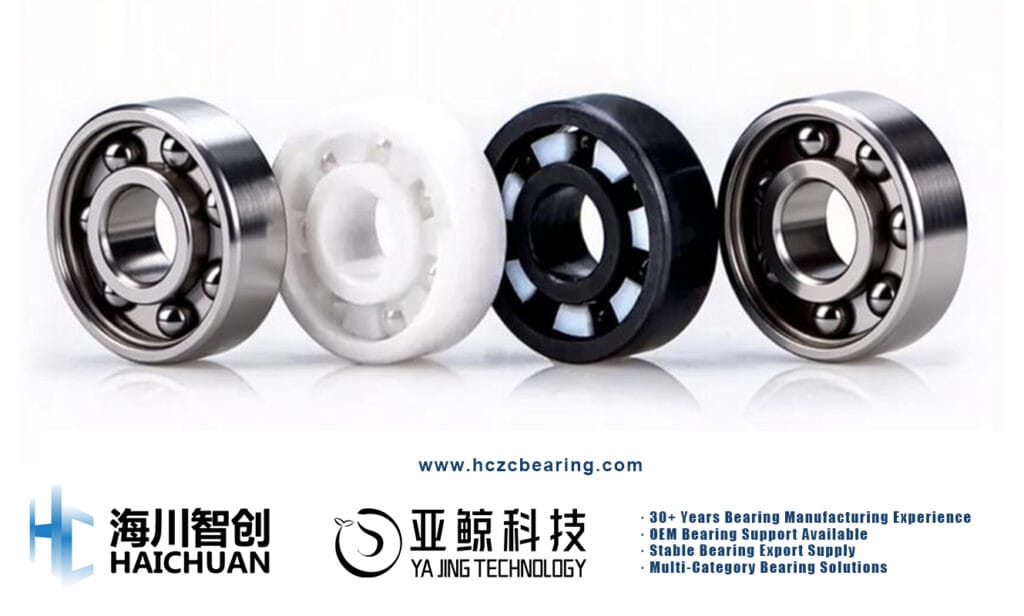
• Material — chrome steel, stainless (AISI 440C/316), or hybrid ceramic.
• Precision — ZV2 / ZV3 low-noise grades for quiet, high-speed runs.
• Noise — graded acoustic levels for appliance and HVAC duty.
• Sealing — ZZ, 2RS, or specialty shields for contamination defense.
• Cage — stamped steel, brass, or polymer for speed and lubricant compatibility.
• Packaging — bulk, single-box, or private-label for OEM lines.
This matrix is what lets a procurement team specify one part number and receive a bearing engineered for the exact application.
For the full method, our bearing selection guide and bearing materials guide go deeper—and our bearing precision grades explain ZV2/ZV3 in detail.
Common Bearing Type Selection Mistakes
Even experienced teams repeat the same bearing-selection mistakes:
• Choosing by size only — a dimensional match is not a performance match.
• Ignoring load direction — fitting a radial bearing where thrust dominates guarantees early failure.
• Ignoring misalignment — rigid bearings in flexible mounts wear fast.
• Overlooking speed — exceeding a bearing’s limiting speed cooks the grease and pits the raceways.
A municipal maintenance crew specified a standard rigid bearing for a water-pump rebuild because the bore and OD matched the old part. They missed that the previous failure was misalignment from a worn pedestal. Within weeks the replacement overheated and seized, forcing an unplanned shutdown during peak demand. The fix—a self-aligning type chosen per the five-factor process above—finally held. Most mistakes in this list trace back to skipping that check, and choosing the wrong bearing type is rarely a spec error alone: it is a process gap.
Bearing Type Comparison Chart
A bearing types comparison shows how the seven main families differ in load capacity, limiting speed, self-aligning ability, and typical applications—so you can shortlist candidates before running the five-factor selection method.
This bearing types comparison is a starting point; confirm with the five-factor method in the selection section above.
| Type | Load Capacity | Speed | Self-Aligning | Typical Applications |
|---|---|---|---|---|
| Deep Groove Ball | Moderate | High | No | Motors, pumps, fans, appliances |
| Angular Contact Ball | Moderate (combined) | High | No | Spindles, precision pumps |
| Self-Aligning Ball | Moderate | Medium | Yes | Long shafts, textile, conveyors |
| Cylindrical Roller | High (radial) | High | No | Gearboxes, motors, mills |
| Tapered Roller | High (combined) | Medium | No | Automotive, agricultural, gearboxes |
| Spherical Roller | Very high | Medium | Yes | Mining, crushers, conveyors |
| Needle Roller | High (radial) | Medium | No | Transmissions, compact gear sets |
Related Guides
New to bearing specification? Walk through the step-by-step bearing selection guide, understand internal clearance (bearing clearance guide), choose the right bearing materials guide, and decode ZV2/ZV3 precision grades.
FAQ
1. What are the main types of bearings?
Ball bearings (deep groove, angular contact, self-aligning, thrust) and roller bearings (cylindrical, tapered, spherical, needle, thrust roller) make up the main families, plus housed units like pillow blocks.
2. What is the most common type of bearing?
The deep groove ball bearing is the most common type in service. It is cheap, universally stocked, and proven across decades, which is why it handles radial and moderate axial load at high speed in everything from appliances to industrial motors.
3. What is the difference between ball bearings and roller bearings?
Ball bearings use point contact, giving low friction and high speed but lower load capacity. Roller bearings use line contact, giving higher load capacity and shock resistance at lower speed.
4. Which bearing type is best for heavy loads?
Spherical and cylindrical roller bearings carry the highest loads; spherical rollers add self-aligning tolerance for misaligned, shock-loaded shafts.
5. Which bearing type is best for high-speed applications?
Deep groove and angular contact ball bearings, and high-precision cylindrical rollers, suit high-speed duty thanks to low friction.
6. What is a self-aligning bearing?
A self-aligning bearing (self-aligning ball or spherical roller) has a spherical raceway that tolerates shaft deflection and misalignment without premature wear.
7. How do I choose the right bearing type?
Work through load, speed, alignment, space, and environment in order, then apply a 6-axis customization check—see our bearing selection guide.
8. Which bearing type is commonly used in electric motors?
Deep groove ball bearings, especially the 6200, 6300, or 6400 (heavy-duty) series, are the standard motor support because they are quiet, cheap, and high-speed capable.